There are many reasons for fleeing one’s home country, and just as many different routes of escape. Once they arrive in their host country, refugees face new challenges. Here, we tell the story of Bereket Hagos (39) from Eritrea, who sought – and, to some extent, found – a new home in Switzerland.
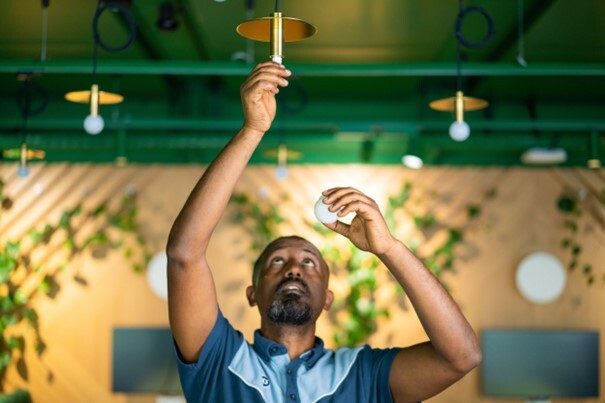
Bereket Hagos’ integration into Swiss society would have been virtually impossible without the support of his employer, ISS Switzerland, and its client, Deloitte. With their help, this family man not only found a job but also, to some extent, a new family.
Bereket, you fled Eritrea and came to Switzerland after a long journey. How did that come about?
In 2015, I decided to flee to Switzerland after a colleague who was already living here told me about his positive experiences. Alone and without my family, I sought refuge here and better living conditions.
What was it like for you to arrive in Switzerland and find your way in a new environment?
It was very difficult at first. I felt isolated and initially had hardly any contact with Swiss people. I took a German course at the Autonomous School of Zurich for about three months, but then I unfortunately had to stop because I didn’t have enough money for public transportation. But after receiving my permit, I was able to continue learning the language for another six months at the Canton of Zurich’s Asylum Organization (AOZ). That support was crucial for me.
Can you describe that in more detail? What challenges did you face as a refugee in Switzerland, and how did you deal with them?
The biggest challenges were - and still are - finding my place in society, making friends, and learning the language. I also still feel very homesick for my family, friends, and relatives. I’ve always tried to focus on my goals and adjust to my new surroundings step by step. The patience and openness of the people I’ve had the chance to meet have helped me the most. That’s how I was able to gradually build trust and establish a new social network.
What differences between your home country, Eritrea, and Switzerland have particularly struck you?
I really enjoy living in a safe country. I’m particularly impressed by how punctual public transportation is - I’m not used to that from my home country. It’s really great to be able to count on buses and trains always being on time. Even my cousin, who lives in the U.S., isn’t used to that kind of reliability. (laughs)
How did you get started in your career?
In Eritrea, I worked at a tourism office and as a bartender at a nightclub. However, I didn’t want to continue doing those jobs here. At first, I had the opportunity to do an internship in nursing at a retirement home. Unfortunately, that didn’t work out, even though I enjoy working with people. I specifically asked the Swiss Red Cross for help: “How can you help me? I’m looking for a job.” They then assigned me a mentor, and together we wrote job applications. With her help, I eventually landed the job at ISS Switzerland on the Deloitte contract.
When and how did you start at ISS?
In May 2021, I had the opportunity to spend a day getting a feel for the workplace at the former location in Enge. I really liked it and was thrilled when I was offered the job as a handyman. After three months, my boss at the time asked me if I’d like to pursue the EBA certification in maintenance. Although I was initially unsure whether I could meet the academic and financial requirements, I said yes. Fortunately, ISS Switzerland covered the training costs, and I quickly realized that the language was the only real challenge. Everything else went smoothly.

How did you feel when - thanks to your good German skills, your hard work, and your punctuality - you were given the opportunity to start an apprenticeship at ISS?
I felt very happy and valued. It was a great opportunity for me to first complete the integration pre-apprenticeship (INVOL), which provides refugees and temporarily admitted persons with targeted, hands-on preparation for a vocational apprenticeship. I then began my apprenticeship in 2022.
Opportunities for Refugees in the Workplace
An outstanding example is our structured “Integration3” program, which we developed in 2018 in collaboration with Deloitte and have since been successfully implementing as a major initiative. It offers educational, employment, and entrepreneurial opportunities, supplemented by targeted language courses as well as social and community support. In this way, participants gradually develop into full-fledged employees. A secure job is an important milestone for refugees as they build a new life. Our goal for the coming year reaffirms our tireless commitment to providing underrepresented groups with equal access to opportunities.
What were the biggest challenges during your training, and how did you overcome them?
The only challenge was the language. Otherwise, everything went smoothly. (laughs) To improve my language skills, I spoke German a lot with my coworkers. The support from my boss and coworkers was very helpful. They were very patient and helped me whenever I didn’t understand something. Over time, my German got better and better, and I felt more and more confident in my work environment.
How did ISS support and encourage you during your apprenticeship?
ISS covered the costs of my training, provided me with a laptop, and took care of my train tickets - and always believed in me. That support was invaluable to me.
What are your personal plans and goals - and, now that you’ve successfully completed your apprenticeship as a maintenance technician (EBA) - for your future at ISS?
Professionally, I’d like to continue working at ISS and on the Deloitte account. I really enjoy my job because no two days are alike. It’s always very varied, and I never know what to expect in the morning when I get to work. I really like that. On a personal level, I’m currently looking for an affordable apartment so I can bring my family over. For my two teenage sons, my wife, and me, having our own apartment is very important so we can start a new life together in Switzerland and the boys can go to school here. In Zurich, however, this isn’t quite so easy to achieve.
“Since 2023, over 354 refugees have been employed by ISS Switzerland. We’re proud of that.”
— Tanja Aebi, P&C Director
