The climate targets are clear: by 2030, the ISS Group aims to achieve net-zero CO₂ emissions from its direct business operations. This is an ambitious target to be achieved within a short timeframe. On the path to achieving a net-zero climate target, it is therefore essential to convert the fleet to more environmentally friendly powertrains.

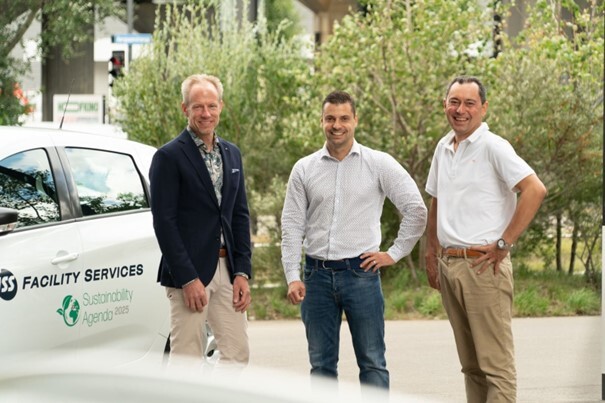
The ISS project group launches the e-strategy at ISS headquarters in Zurich: from left to right, Marc Amstutz (Head of Environment & Sustainability), Stefan Nüesch (Head of the Electric Vehicle Unit for German-speaking Switzerland and Ticino), Jon Flurin Carl (Fleet Manager)
The ISS Switzerland fleet comprises 1,500 vehicles. In total, these passenger cars and light commercial vehicles cover approximately 28 million kilometers each year. As early as 2011, ISS Switzerland had put its first fully electric passenger car into service and equipped its headquarters in Zurich Altstetten with two charging stations. Since then, 85 new electric vehicles have been procured. Now, this initiative is being further expanded. It is clear that by 2024, 50 percent of newly ordered passenger cars and 25 percent of newly ordered delivery vans must be electric. By 2026, the plan is to increase this percentage to 100 percent for passenger cars and 75 percent for delivery vans. The Group’s current strategy still allows for the purchase of plug-in hybrids (PHEVs) in addition to fully electric vehicles (BEVs) in order to reduce our CO₂ emissions.
Launch of the Electrification Agenda in Zurich: One-third of underground parking spaces electrified
In Switzerland, ISS is launching its electrification agenda at the CUBE, its headquarters in Zurich-Altstetten. To this end, an internal project group was formed for this pilot site, consisting of Fleet Manager Jon Flurin Carl and Marc Amstutz (Head of Environment & Sustainability), as well as specialists in the fields of electrical engineering and energy management. The first phase of the project has already been rolled out: Since July, one-third of the underground parking spaces at the CUBE in Zurich have been electrified. The AC (alternating current) charging stations and the software are provided by the Zurich-based company Novavolt, one of Switzerland’s market leaders in this segment. Each charging station has a capacity of up to 22 kilowatts.
This allows an electric vehicle to be charged in one hour for a driving range of 110 kilometers. Thanks to intelligent dynamic charging management, no upgraded building connection is necessary, which also saves costs. And as a result, the lights at the CUBE won’t go out even if all the electric vehicles are plugged in at the same time. The CUBE serves as a pilot project for the widespread introduction of plug-in vehicles at ISS Switzerland and is intended to later serve as a model for implementation across the regions. Which region will install how many charging stations and when is currently being evaluated. “That depends on the procurement and distribution of the electric vehicles,” says fleet manager Jon Flurin Carl. The Novavolt system, which the project group at the CUBE has chosen, is easily scalable. This provides flexibility as ISS gradually replaces its gasoline and diesel vehicles with electric cars.
Climate-Friendly Vehicle Fleet by 2030: 100% Electricity from Renewable Sources
The final and decisive question remains: the origin of the electricity for the new vehicles. After all, electric mobility is only meaningful and climate-friendly if the energy used comes from renewable sources. ISS Switzerland will therefore have to use green power certificates of origin to ensure that, on balance, all electric vehicles are charged with 100 percent electricity from renewable sources. The result will be a climate-friendly vehicle fleet that - based on today’s figure of approximately 28 million kilometers traveled and average emissions of 128 grams of CO₂ per kilometer - saves more than 3,600 metric tons of CO₂ each year and will produce zero CO₂ emissions by 2030. ISS’s (auto)mobile future is going to be electrifying.

Marc Amstutz, Head of Environment & Sustainability
Marc Amstutz has headed the Environment & Sustainability division since 2020. In this role, he is primarily responsible for promoting and implementing ISS’s sustainability goals in Switzerland. Prior to that, he spent ten years in various leadership roles related to sustainability, the environment, and climate at Swiss Post and taught for more than seven years in the Department of Economics at the Lucerne University of Applied Sciences and Arts. Marc Amstutz studied economics, environmental economics, and general ecology at the University of Bern.
“When we reduce our ecological footprint, we also improve our customers’ carbon footprint.”
Marc Amstutz, ISS aims to electrify its entire vehicle fleet by 2030. This transition is part of the Net Zero strategy. How significant is this strategy?
ISS is one of the 50 largest employers in the world. So what we do - and how we do it - matters. For a company’s commitment to the climate and to limiting global warming to be credible and effective, it should align with the goal of the Paris Agreement, which aims to limit global warming to no more than 1.5 degrees. This requires that emissions of greenhouse gases such as CO₂ be reduced to net zero by 2050 at the latest. The ISS Group has set a net-zero target for 2040.
“Net Zero” is easy to say. How will ISS achieve this goal?
Ultimately, we must reduce greenhouse gas emissions wherever possible. If residual emissions remain in the target year, they must be offset - for example, by removing an equivalent amount of CO₂ from the atmosphere through biological or technical measures, or by permanently storing it. The net-zero target applies both to emissions generated by ISS through its own services and to the entire value chain. Direct emissions - such as those from fuels (Scope 1) - and indirect emissions - such as those from electricity consumption (Scope 2) - are to be climate-neutral by 2030. By 2040, this goal will also apply to Scope 3 - that is, all other indirect emissions that fall outside ISS’s sphere of influence but impact the value chain. Scope 3 includes, for example, CO₂ emissions generated by the purchase of products and work materials, the incineration of waste, and employee commuting and business travel.
Is the purchase of CO₂ offset credits also planned?
No, this is not part of the ISS Group’s Net Zero strategy. ISS is committed to the leading Science Based Targets Initiative, which more than 2,200 companies have already joined. This initiative has developed a Net Zero standard for companies. The standard provides a clear, consistent, and scientifically sound definition of net zero and how this goal must be achieved. The initiative is backed by renowned organizations such as the United Nations Global Impact, the Carbon Disclosure Project (CDP), the World Resources Institute (WRI), and the World Wide Fund for Nature (WWF).
How does Net Zero affect ISS’s customers?
Our customers also have climate goals. And if we generate CO₂ emissions while providing a service, those emissions must also be reported on the customer’s side. So, by reducing our environmental footprint, we also improve our customers’ carbon footprint. Conversely, we at ISS have a global program to support our suppliers in making their products and services resource-efficient and climate-friendly. While 2040 is still a long way off, we must start early to put the entire ISS Group on this path to climate neutrality.
So the goal has been set. Is there a concrete reduction pathway?
This roadmap is currently being developed at the global level and will then be rolled out to the country organizations. Prior to this, each country submitted its key performance indicators to headquarters in Copenhagen: fuel consumption, electricity and water consumption, and heating energy. Based on the base year of 2019, the respective reduction pathways are being defined for each country.
Are the goals for the vehicle fleet already very specific?
That’s correct. We’re decisively pushing forward the transition from internal combustion engines to electric vehicles wherever vehicle models are available that also meet our needs - for example, in terms of range. At the same time, we’ll be reducing the fleet by about 10 percent. And, of course, ISS’s electric vehicles will be powered exclusively by electricity from renewable sources in Switzerland.
ISS Group Climate Goals: Net-Zero Greenhouse Gas Emissions by 2040
Lower greenhouse gas emissions mean reduced energy consumption, a transition to renewable energy sources, lower water consumption, less waste, and more climate-friendly mobility for commuting to work or on business trips. The ISS Group has set a goal of becoming completely CO₂-emission-free by 2040. This applies, on the one hand, to direct and indirect CO₂ emissions from ISS’s business operations (Scope 1 and Scope 2, such as fuel for the fleet). Therefore, all CO₂ emissions must be reduced as much as possible by 2030. By 2040, the “net-zero” target will also apply to all greenhouse gas emissions from products used or facilities that are not owned or controlled by ISS but that indirectly impact value creation. These may include, for example, CO₂ emissions from products in use, waste, or heating systems in leased premises.