Electricity consumption for space cooling is rising steadily. To further improve energy efficiency, it will be essential in future to monitor and control cooling consumption. ISS’s new calculation model enables consumption to be recorded cost-effectively and reported accurately.

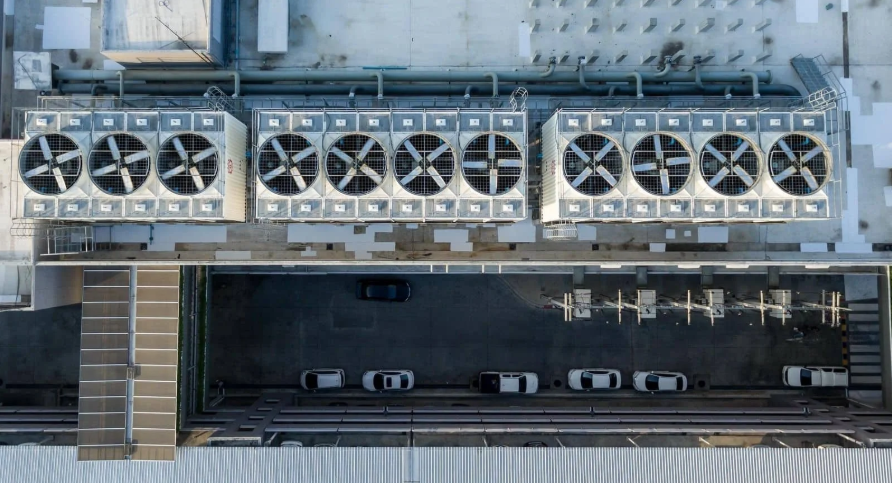
As the digitalization of the workplace continues to advance, the heat load that needs to be dissipated is steadily increasing. In commercial buildings, this means more cooling systems are needed to create comfortable indoor conditions for both occupants and the infrastructure. In addition, climate change is projected to lead to an increase in the number of hot days, causing cooling demand to rise further. For businesses, this means that total electricity consumption is on the rise. At the same time, many companies are doing everything they can to improve their energy efficiency as part of the federal government’s Energy Strategy 2050. To avoid jeopardizing these goals, it will be essential in the future for companies to understand trends in cooling consumption and to be able to implement appropriate measures to reduce it.

Challenge: Tracking Cooling Consumption
Tracking electricity consumption for space cooling poses a particularly challenging task for technology-driven companies with a large, diversified real estate portfolio and a highly complex building infrastructure. Installing comprehensive measurement points in such an environment is hardly feasible at a reasonable cost. Consequently, property managers often lack concrete, actionable data sets on cooling consumption. This raises the question of how companies can cost-effectively collect and report this data in the future.
New Calculation Model: 1,000 Properties Analyzed
To find an answer to this question, ISS analyzed the electricity consumption for cooling in Swisscom’s building portfolio. In this portfolio of 1,000 properties, building size, use, and operational purpose vary greatly. The spectrum ranges from simple technical operations centers in rural areas to business parks and large data centers. A similar diversity exists in the cooling systems used, which must meet the various operational requirements. Everything is present, from geothermal cooling systems and ground-source heat exchangers to hybrid recoolers, chillers, and simple outdoor air cooling systems with fans.
To calculate cooling energy consumption in extensive and diverse building portfolios, ISS has developed a new extrapolation model. Using data from the energy monitoring system, individual measurements, and benchmarks, the total electricity consumption for cooling can be determined.

Extrapolation: Measurement Data and Benchmarks
In the current study, buildings from seven categories were selected, such as large business parks and technically used operational buildings. Building clusters were then formed based on size, type of use, and type of cooling and linked to corresponding benchmarks. For the so-called “remaining portfolio” - which comprises all buildings without measured and analyzed data - ISS determined consumption data using the generated benchmarks. By extrapolating from measured and estimated data, a reliable estimate of total energy consumption for cooling can be derived.
Energy Monitoring: Identifying Savings Potential
To validate the data, it is advisable to monitor the measured buildings at least monthly through energy monitoring and to report the results in a detailed report. The collected data also provides information on deviations and highlights potential energy savings. Monitoring, extrapolation, and reporting of climate-adjusted cooling energy consumption will become an integral part of energy management in the future. As a result of climate change and increasing levels of technological sophistication, the demand for cooling energy will rise. Using the developed extrapolation model, companies and managers of large real estate portfolios can determine total demand in a cost-effective and practical manner.