With its Sustainability Agenda 2025, ISS Switzerland aims to set an example of how a company can implement global sustainability goals. For example, by using circular economy approaches.
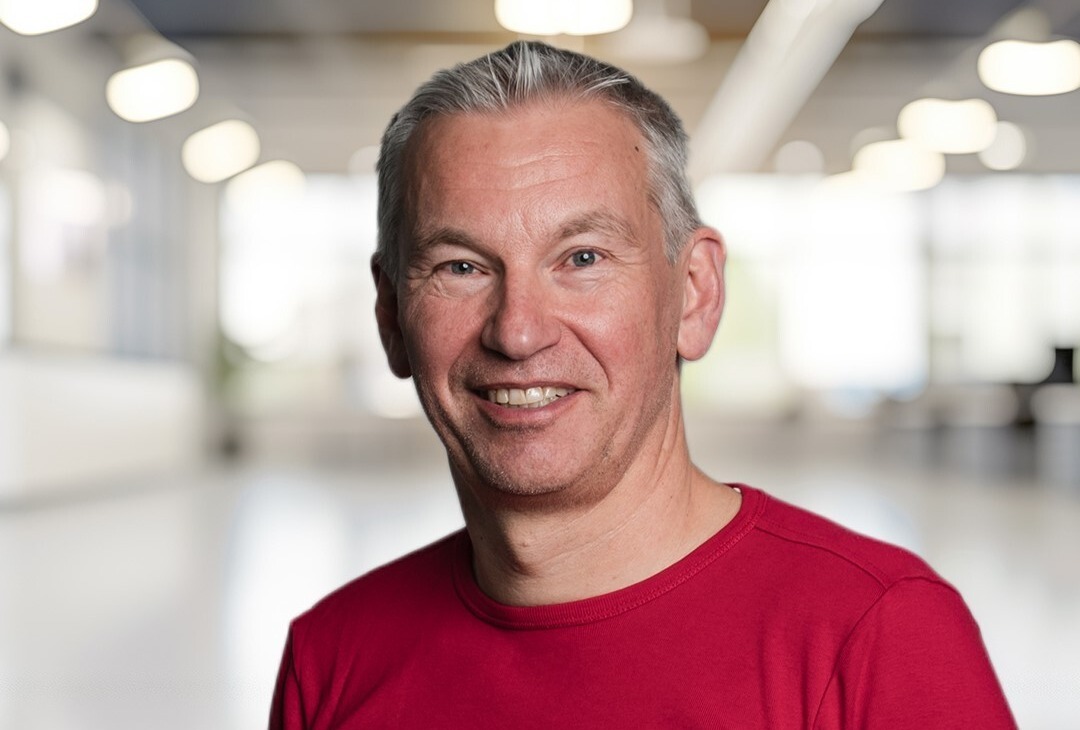

Marc Amstutz, Head of Sustainability & Environment
“With a consistent plastic collection program, we can reduce over 20 percent of our waste at the ISS headquarters, Cube, which would otherwise end up in incineration.”
This has never happened before: of all places, at ISS Switzerland’s headquarters, the Cube, a mountain of plastic waste is piling up - and it’s been going on for a whole month! That’s how long the “Plastic Free Month” campaign will last - an initiative ISS Switzerland is launching this fall to raise awareness among employees in Zurich-Altstetten about the responsible use of plastic. The mountain represents the amount of plastic collected each month at the Cube and recycled through the “Bring Plastic Back” collection system - instead of simply ending up in the general waste.
Certified Collection System: Circular Economy at ISS
To counteract this, ISS has been working since 2020 with the national “Bring Plastic Back” collection system operated by InnoRecycling AG in Eschlikon, Thurgau. The certified collection system features a transparent, environmentally conscious material cycle with an 80% value retention rate in Switzerland. The collected plastic is picked up by regional partners. After sorting, the single-type plastics are sent to specialized recycling companies. There, the single-type plastics are processed into regranulate, which can then be used to manufacture new plastic products. This reduces CO2 emissions and energy consumption in plastic production by nearly half. However, the cost of recycling is borne by the customer - in the case of the Cube, that is, ISS.

"We make plastic sustainable"
3R Approach: Reduce, Reuse, Recycle
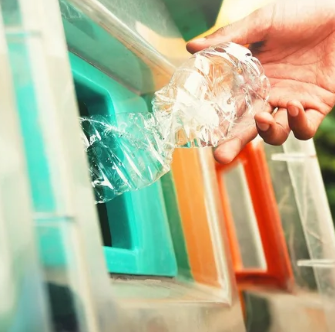
Of course, it would be best if there weren’t so much plastic waste to begin with. That’s why ISS follows the 3R approach - “reduce, reuse, recycle” - in its waste management. First and foremost, this requires the appropriate infrastructure: On every floor of the Cube, there are central waste sorting stations - the recycling stations. Here, ISS employees can dispose of paper, PET, aluminum, general waste, and - marked in yellow - plastic.
The personal trash can has had its day. “Thanks to the plastic collection program, we can reduce over 20 percent of our waste that would otherwise end up in incineration. And thanks to the recycling stations, we can send about two-thirds of our waste at the Cube for recycling,” says Marc Amstutz, Head of Sustainability & Environment at ISS Switzerland.
Second, awareness campaigns like “Plastic Free Month” are necessary to reduce plastic, explains Marc Amstutz. For example, during this campaign, ISS employees were able to order sustainable, reusable lunch boxes to pack their food at home or when getting takeout. ISS is also switching to plastic-free alternatives for office supplies wherever possible. Waste bags made from recycled plastic are used throughout the Cube.

Small investment, big impact: Thanks to the recycling stations at ISS headquarters (the Cube), ISS is able to recycle two-thirds of its waste.
One of three focus areas: Customer benefits
In the future, more ISS customers are set to benefit from these experiences in the circular economy. “We are continuously developing new sustainability services, have established corresponding processes, and have built partnerships,” says Marc Amstutz. ISS is already implementing plastic recycling, for example, for numerous major customers throughout Switzerland.
“Circular economy and recycling management” is just one of three focus areas that ISS Switzerland aims to implement in collaboration with its customers over the next few years, in line with the UN Global Compact (see last paragraph). Other areas of focus aim to optimize energy efficiency in buildings or design environmentally friendly, flexible, and experience-oriented workplaces.
For Marc Amstutz, it’s clear that investing in sustainability pays off: “We have a responsibility to protect our planet through environmentally friendly services, and in doing so, we support our clients who share that same responsibility.” In general, Amstutz says, the topic of sustainability will become even more important in the future as a source of added value and for the company’s reputation among end customers and potential employees.
UN Global Compact: From global sustainability goals...
For 20 years now, the ISS Group has been a member of the UN Global Compact, the world’s largest initiative for sustainable corporate governance. Through the 17 Sustainable Development Goals (SDGs), the United Nations also outlines key environmental issues for companies, ranging from “Climate Action” to “Responsible Consumption and Production.”
Customer Requirements: … Toward Concrete Implementation
To translate such broad goals into concrete action, every company faces the question of which goal to tackle and how. Where is the impact and benefit greatest? ISS Switzerland has also given this careful consideration—on the one hand, through dialogue with other companies that have joined the national network of the UN Global Compact, and on the other hand, through discussions with major clients and in strategy meetings. “We sought the greatest overlap between the expertise we possess, the contribution we can make, and the requirements of our customers based on their sustainability goals,” explains Marc Amstutz, Head of Sustainability & Environment at ISS Switzerland. This led to the focus areas of the Sustainability Agenda 2025: 1) climate-friendly solutions, 2) environmentally friendly work materials and supplies, 3) circular economy and recycling management.