The term "electricity shortage" was chosen as the word of the year 2022. Indeed, until January, it was unclear whether there would be enough electricity in Europe at all times during the winter of 2022/23. The federal government's action plan included, among other things, quotas for large consumers. To prepare for this, the consulting firm Deloitte and ISS worked closely together.

If there is an imbalance between energy supply and energy consumption over an extended period, this is referred to as an energy shortage. To prevent blackouts, the federal government had already drawn up a four-step action plan in the fall. The plan included calls for energy conservation, restrictions on lighting (e.g., Christmas lights, illumination of historic buildings), as well as electricity quotas for large consumers. “Ostral,” the organization responsible for electricity supply in extraordinary situations, is in charge of planning and implementation. This includes energy supply companies responsible for electricity generation, the transmission grid, and the distribution grid.
Avoiding Electricity Quotas
You don’t need to consume a massive amount of electricity to be considered a large consumer. A company falls into this category if it uses as little as 100,000 kilowatt-hours per year. To put this number into perspective: 100,000 kWh is roughly equivalent to the consumption of 22 single-family homes. Thirty thousand companies in Switzerland are so-called large consumers and would therefore have been affected by rationing - including the consulting firm Deloitte. For the past ten years, ISS has been responsible for facility management - including building services - at Deloitte in Switzerland, which has more than 2,500 employees. This also includes energy management.
In its Management Ordinance, the Federal Council specifies the amount of electricity that large consumers must conserve or the electricity quota to which they are entitled in the event of an acute shortage. This electricity quota is calculated based on a reference amount, which generally corresponds to the month preceding the month subject to rationing. However, the ordinance also gives affected companies the opportunity to avoid any quotas - specifically, if they have already verifiably saved a sufficient amount of electricity in advance.

Energy consumption is monitored regularly and adjusted as needed.
Helping Customers Save Energy
And this is where ISS came into play: With its “Pre-Energy Shortage” program, ISS has developed a system that helps customers reduce their energy consumption. Based on a detailed analysis, scenarios are calculated and measures are implemented. These measures are regularly reviewed and adjusted as necessary. BCM@ISS (Business Continuity Management) ensures a systematic approach.
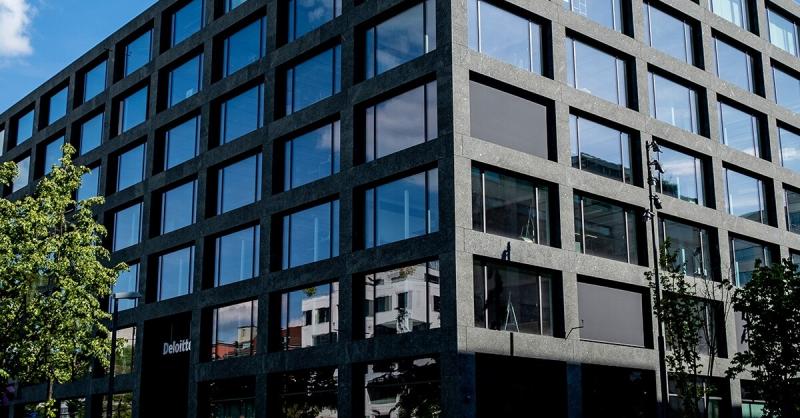
At Deloitte’s headquarters in Zurich, which has approximately 960 workstations, ISS Energy Manager Marjan Smolka analyzed the cooling generation and distribution, the lighting, the ventilation systems, and the energy consumption of various electrical appliances, namely coffee makers, TVs, monitors, and refrigerators. “We analyzed all systems according to the criteria for quota allocation,” says Marjan Smolka. “When it came to the measures, we wanted to avoid zone-by-zone shutdowns and also refrain from across-the-board reductions that would significantly restrict day-to-day work.” At first glance, the measures seem correspondingly simple: slightly lower the temperature in the office spaces, reduce cooling in the server rooms, dim the lights, turn off the heating elements on coffee makers, and post signs on the elevator doors reading “Please use the stairs.”

Thanks to the ISS “Pre-Energy Shortage” program, electricity consumption is down by about 10,000 kWh per month.
Measures Will Continue
The measures are simple but highly effective: Deloitte was able to reduce electricity consumption at its headquarters by about 10,000 kWh per month in this way - enough to avoid being affected by any potential electricity rationing. “The measures were originally intended to be only temporary,” says Marjan Smolka, as they are likely to result in some loss of comfort in the workplace. Although there were no electricity quotas in the winter of 2022/23, Deloitte has decided to maintain the measures until further notice. In doing so, the consulting firm is sending a clear message about sustainability.