Glass, PET, aluminium, as well as construction waste, electronic waste and biogenic waste. In Switzerland, around 70 per cent of all waste is recycled. Now, ISS Switzerland, in collaboration with Essity – the world’s leading hygiene and health company – and Tork PaperCircle®, is closing the loop on paper towels. This reduces the volume of waste in office buildings by up to 20 per cent and CO₂ emissions by up to 40 per cent.

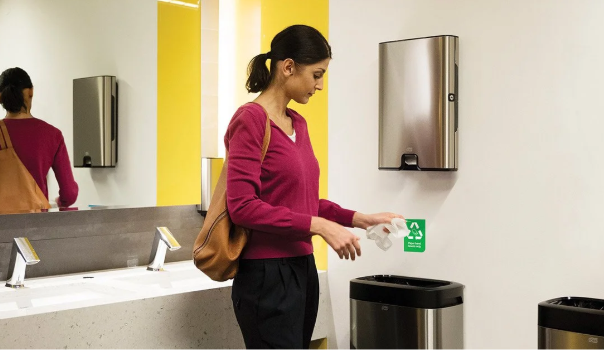
There is still room for improvement in paper recycling: Tons of paper towels from restrooms in office buildings and public facilities have so far ended up in waste-to-energy plants. While 82 percent of regular paper is recycled in Switzerland, the picture is quite different for paper towels: here, the recycling rate is less than one percent!
20 Percent Waste
About 20 percent of the waste generated in a large office building consists of paper towels. It is undisputed that there are more environmentally friendly alternatives to paper for drying hands. “Air dryers undoubtedly have the best environmental footprint,” says Marc Amstutz, Head of Environment & Sustainability at ISS Switzerland. The fact that paper towels are still in extremely high demand in Swiss office buildings has to do with customer needs: “Paper is perceived as more hygienic and more versatile: for example, you can also use it to dry your glasses or wipe a coffee cup. Air dryers can’t do that.” In addition, a hand dryer is relatively noisy and requires an electrical outlet. From this perspective, paper towels have some advantages.
To make up for this in terms of the environmental footprint, it generally makes sense to use paper towels from responsibly managed forests with the FSC label and to return them to the paper recycling loop. To this end, Tork PaperCircle® now provides a separate recycling process that improves the recycling and recovery rates of paper towels.
Switzerland’s first recycling service of its kind
And this is where facility management comes into play: In cooperation with Essity, ISS offers its customers the opportunity to close the recycling loop for paper towels as well. It is the first recycling service of its kind for paper towels in Switzerland, which ISS is offering to various customers in the greater Zurich area. “Demand is high,” says Marc Amstutz. This comes as no surprise: “Our clients are also pursuing net-zero climate goals. That’s why we’re helping them send recyclable materials to recycling and conserve resources. In this way, we’re helping them reduce waste volume, increase the recycling rate, and thereby lower their carbon footprint.”
Here’s a calculation: An office building - such as the ISS Switzerland headquarters - where 300 employees work 230 days a year and wash their hands three times a day uses about 1.7 metric tons of paper towels per year. Recycling paper towels can save approximately 1.9 metric tons of CO₂ in production and disposal. This figure, in turn, corresponds to the greenhouse gas emissions of ten flights from Zurich to London. Thanks to the annual volume of paper towels recycled through the CUBE, the production of new hygiene paper also saves energy, water, and the amount of usable wood equivalent to four medium-sized spruce trees.

Collect and Recycle
To increase recycling rates among its customers, ISS Switzerland relies on the TorkPaperCircle® program developed by Essity under the Tork brand. This is because paper towels contain wet-strength agents to give them greater tear resistance when wet. This distinguishes them significantly from other paper products, making them unsuitable for standard paper recycling. To address this, a separate extraction process has now been developed to enable recycling. In buildings managed by ISS, these Tork paper towels can now be collected separately and recycled.

ISS collects the used paper towels separately and transfers them to a waste management company for storage - until enough compressed paper towels have been collected to fill an entire truck. This truck transports the paper to Mannheim to paper manufacturer Essity, the company behind the Tork brand. There, the used paper is recycled and processed into new paper products. It is important that the used paper towels are collected separately and are not contaminated. This means you can no longer simply toss the paper into the trash can and throw in stale chewing gum at the same time. Separate collection is ensured by clear signage. These signs are placed near the collection bins and remind users to dispose of only paper towels in the designated containers. This improves the quality of the collected material, increases the recycling rate, and demonstrates the company’s commitment to environmental sustainability.
Up to 40 percent fewer CO₂ emissions
And if you’re now wondering whether it makes sense to transport used paper from Zurich to Mannheim: Yes, it is, because the greenhouse gas emissions generated by the transport account for only a small fraction of total emissions. In return, the return of used paper towels saves a significant amount of energy in the production of new paper products. The Essity study shows that the circular economy for paper towels reduces the amount of waste generated in an office building by the 20 percent mentioned earlier and cuts CO₂ emissions by up to 40 percent - including transportation to the paper mill in Mannheim.
Thanks to Tork PaperCircle®, the circular economy for paper towels is becoming a reality. ISS thus supports companies in achieving their climate goals, and they send a visible signal of their environmental commitment to both employees and customers.
Recycling in Switzerland
In Switzerland, a good two-thirds of the total waste volume is recycled. The recycling rates for municipal waste are impressive: Since 2005, more than half of municipal waste has been returned to the economic cycle as secondary raw materials (2019: 53%). According to Swiss Recycling, the recycling rate for waste paper is 82%; for waste glass and aluminum, it is 94% each; for PET beverage bottles, 91%; and for batteries, 64%. For paper towels, the rate is currently less than 1% - so there is still significant potential here.