Seven days a week: since October, ISS has been ensuring that railway stations across French-speaking Switzerland are clean and well-maintained, thanks to a comprehensive range of services. Following a public tender, SBB has awarded ISS the facility management contract for more than 240 SBB stations. Patrick Bumann, Head of Key Account Management for French-speaking Switzerland, gives us an initial insight into how ISS is tackling this challenging task.
.png?width=1620&height=2025&name=Design%20ohne%20Titel%20(17).png)
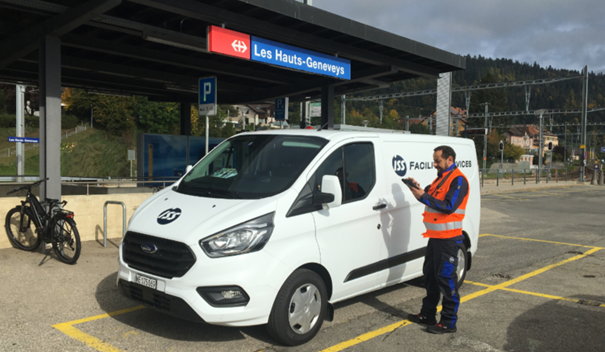
“What makes this task so complex is not only the large number and varied structure of the station facilities, but also the geographical scope and the SBB’s requirements regarding operational safety and passenger safety,” says Patrick Bumann, summarizing the service mandate.
Consistent Quality from Lake Geneva to the Valais
The service contract is impressive and encompasses comprehensive facility management services at 240 low-traffic stations: property management, maintenance of stations, ancillary buildings, individual platforms, and logistics areas; interior cleaning; grounds cleaning; maintenance of building services systems; landscaping; pest control; graffiti removal; waste disposal; help desk; and winter maintenance. A dedicated on-call service ensures that issues reported by customers and SBB via the help desk are resolved as quickly as possible. The regional manager responsible for the property is in charge of this. ISS organizes winter services in parallel with the existing operational teams. This is the only way to ensure that snow removal can be carried out simultaneously at all locations throughout French-speaking Switzerland in the event of a severe winter storm. “This contract places significant logistical demands on our teams,” says Patrick Bumann. “We must ensure the high standard of service and ISS quality at every location - seven days a week - from Lake Geneva, the Three-Lakes Region, and the Jura all the way to the Valais.”
From 0 to 100 in just 3 months
The geographical scope, as well as the large number and complexity of the buildings, also posed a challenge for Rémy Croset, who, together with his team, got everything ready for the operational launch on October 1 in just three months. “Taking stock of the portfolio was a Herculean task due to the diversity of the properties and the short timeframe,” said Croset. “We inspected all 240 facilities during the summer break, analyzed the station buildings, technical facilities, platforms, logistics areas, and green spaces, and documented all the details necessary to fulfill our service mandate.” Based on this, the ISS team developed a zoning plan that coordinates operations from the Geneva, Vaud/Valais, and Neuchâtel/Fribourg branches. Work materials and vehicles had to be organized and made available at the ISS branches. Work processes were defined, and job descriptions were developed for recruiting skilled personnel.

Regional Pool of Specialists Recruited
ISS had to recruit specialists in various cantons and train them for their new roles in record time. ISS was also able to recruit former SBB employees for the new positions, thereby securing valuable expertise. All employees had to complete the occupational safety training required by SBB before their first day on the job. Patrick Bumann sees ISS’s strong presence in the cantons of Geneva, Vaud, Fribourg, Neuchâtel, and Valais as a major advantage. “Our employees are familiar with regional and local conditions. We also have the necessary pool of skilled workers. This means our employees can be on site quickly, even in the event of unexpected incidents such as damage caused by severe weather or acts of vandalism.”

High Safety Standards
Safety is a key priority for SBB and ISS: Trains pass through stations at 140 kilometers per hour, and high-voltage power lines carry up to 15,000 volts; accordingly, the safety standards that every ISS employee must adhere to are very high. Recurring training courses teach the correct procedures. For example, employees must not come within 1.5 meters of high-voltage power lines. And when cleaning the platform, they must not cross the white line at the edge of the platform. If ISS employees discover dirt or trash on the tracks, they report the issue to SBB, which then resolves the problem. “To further reduce the risks associated with high-voltage power lines, we have also replaced all metal tools and equipment - such as tongs for picking up trash or ladders - with plastic alternatives,” adds Patrick Bumann.
“We are very proud to have been awarded this complex contract. With our expertise in the transportation and transit sector and our motivated teams, we are doing everything we can to meet the expectations of SBB and its customers.”- Christophe Favier-Bosson, Managing Director, ISS Western Switzerland
SBB’s expectations are high. Thanks to its geographic presence in Western Switzerland and its high level of in-house production, ISS’s stated goal is to guarantee a consistently high standard of quality at all stations. Through regular reporting and communication with the client, the quality of service delivery is monitored and adjusted as needed. “We can directly contribute to the satisfaction of SBB customers through our work,” says Patrick Bumann with conviction. When travelers are satisfied, so is SBB.