The energy crisis and the resulting rise in energy and raw material prices are currently having a significant impact on the construction and property sectors. Those in charge are facing enormous challenges – and facility management is becoming increasingly important.

Alternative supply models, more diverse supply chains, measures to reduce energy consumption, and compliance with ESG criteria in accordance with the EU Taxonomy guidelines: these are all issues currently on the real estate industry’s mind. This is not surprising, as buildings - depending on their age and condition - have a significant environmental footprint.
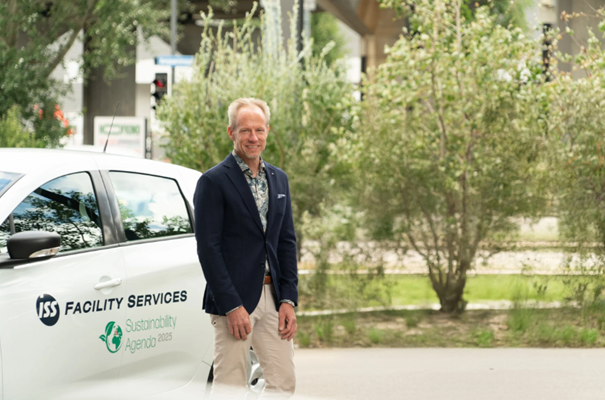
Facility management faces significant challenges as a result. It plays a key role in achieving climate goals and is increasingly shifting from being a mere administrator to a driver of change. The organizer discussed this topic with Marc Amstutz, Head of Sustainability at ISS Switzerland.
Mr. Amstutz, how is the issue of sustainability currently changing facility management? And where is this change particularly pronounced?
In general, there is a growing demand everywhere for a clearer commitment to greater sustainability. This applies to all FM service providers. Clients want to see us contribute to achieving environmental goals, as well as to meeting ESG reporting requirements. Sustainability must also be viewed from two perspectives - first, from an economic standpoint. There is increasing cost pressure. Clients want to avoid vacancies resulting from changing work patterns - such as working from home. Property owners are also increasingly seeking to obtain sustainability certifications for their buildings. On the other hand, there is the environmental focus on achieving a climate-neutral building portfolio.
In this context, reporting requirements are becoming more stringent. Here, we can support our clients, for example, with the collection and quality assurance of energy data or with the implementation of measures to improve energy efficiency. In the best-case scenario, this results in an ecological and economic win-win situation. Unfortunately, however, this is not always the case. For buildings with outdoor spaces, measures to promote biodiversity are also becoming increasingly relevant. These have both environmental and economic value - for example, because they make us more resilient in the face of climate change. But they do entail initial costs.
What exactly would need to be in place for such a win-win situation to arise?
Such a situation can be achieved above all when it comes to increasing energy efficiency - for example, through the use of renewable energy, building automation, or the general energy optimization of systems within a building. These are measures that can be implemented in the short term. In the longer term, comprehensive renovation projects are on the table that can contribute to a climate-neutral building stock. This includes, for example, retrofitting machinery or replacing heating systems; these investments typically pay off only after some time.
But the fact is: the clock is ticking, and climate goals must be met by a specific deadline. This means we need to move forward with more sustainable buildings. How does this affect your business?
We see that there are many short-term, quickly implementable measures - such as energy inspections, operational energy optimizations, or energy management. You gather the data once and can quickly determine where you stand and whether the systems are properly configured. Or even switching to eco-friendly cleaning products can make a big difference. With other issues, it takes a little longer. In those cases, you first have to thoroughly analyze a building and assess which renovation project - replacing the heating system or upgrading the building envelope - is most suitable.
And what is ISS itself doing, including with regard to meeting ESG criteria?
Internally at ISS, the focus is on three key areas: climate and energy, materials and waste, and facilities and equipment. We’re working to optimize our performance in all three of these areas and have set net-zero targets for 2030 (Scope 1 and 2) and 2040 (Scope 3) - for the entire corporate group and ISS Switzerland. In addition, we have set short-term climate targets that are recognized by the Science Based Targets Initiative (SBTi).
“Our facility management services make an important contribution to our clients’ environmental and climate goals.”
It’s clear that we now need to improve our approach across all our services as well as our buildings to reduce our carbon footprint. For example, we’re reducing our fleet by consolidating trips and increasing the proportion of electric vehicles. We also offer public transportation passes or combined mobility options. Furthermore, we’re increasingly striving to use equipment and materials that were manufactured with lower CO₂ emissions. Internally, we also maintain an equipment pool in some regions. If a specific cleaning machine is needed at a particular location, staff can access this pool.
This sharing model allows us to reduce our equipment fleet. In addition, we have a comprehensive program for reducing greenhouse gas emissions throughout the entire supply chain. We are therefore discussing with our key suppliers ways to obtain more climate-friendly products that both we and our customers use.
That means you can also make an impact with your customers. Do these more environmentally friendly solutions cost more?
Yes, that may well be the case. However, our customers also receive environmental value in return thanks to our services. By reducing our own CO₂ emissions, we automatically contribute to achieving our customers’ climate goals. This is because the services we provide to our customers are part of their carbon footprint (Scope 3).
In addition, our services also help improve building ratings, such as GRESB (Global Real Estate Sustainability Benchmark). This rating is crucial for owners of real estate portfolios. Providing data is becoming increasingly important in this context. We are working to make the data we collect from the buildings we manage available to our clients so they can use it for their reporting.

ISS also implements energy-efficient operational optimizations - a significant step toward more climate-friendly buildings.
The construction and real estate industries, in particular, are under close scrutiny in the sustainability debate. Many buildings are in need of renovation or even need to be rebuilt. When it comes to such discussions - renovate or rebuild - what is the stance of a facility management service provider in each case?
For us, a building is sustainable when it has the smallest possible ecological footprint or even makes a positive contribution to the environment, as is the case, for example, with energy-plus houses or buildings with surrounding green spaces that promote biodiversity. Ideally, sustainable materials are used right from the construction phase. Renovating an old building is often more sensible than tearing it down. You have to view a building as a whole system and determine how to operate it as efficiently as possible.
This means that materials and substances introduced into this system should come from sustainable sources and support the transition to an energy-positive building. Renovations and operational optimizations are extremely effective building blocks for solutions. We are very active in this area and offer comprehensive building analyses. We have programs that allow us to implement specific renovation projects in collaboration with construction project management. If such projects are approached correctly, renovations can yield significant benefits.
However, this “proper approach” does not always seem to be the case everywhere. Often, the approach resembles a “patchwork policy”: people simply renovate whatever is most urgent.
That may be a subjective impression. With our major clients, we see that, on the one hand, they want to switch to renewable energy sources for heating, but on the other hand, they’re also tackling renovations of the building envelope at the same time. This is an approach that we always recommend ourselves. But ultimately, these are always investment decisions. Lifecycle management also plays a role, and property owners approach it in very different ways.
Each of our clients has their own climate protection roadmap. Our role as a facility management service provider is to support them in implementing this roadmap through our wide range of environmental services.
For large clients, this seems to be a given. However, there are many small property owners, including SMEs, who often do not have a “fully developed” facility management system in place. Where should these organizations start?
A first step is certainly a building analysis and viewing the building as a holistic system with inputs and outputs. This makes it easier to identify the “low-hanging fruit” that can yield quick wins. Take, for example, our services in the area of energy management: Optimizing systems during operation has a positive impact on the environment and leads to lower operating costs. But a great deal can also be achieved with our eco-friendly services in the areas of building cleaning, waste separation, and recycling cycles. From a purely CO₂ perspective, however, the energy sector offers the greatest leverage: reducing water consumption and increasing energy efficiency.
And even SMEs can get started with this. Those who have set net-zero climate goals will only achieve them through circular economy measures. Simply focusing on reducing CO₂ in some way is not enough. We will only reach our goals if we succeed in keeping materials within closed-loop systems. At ISS, we have therefore identified another recyclable material commonly found in office buildings: paper towels. These account for up to 20 percent of waste. Thanks to the “ISS PaperCircle” service, these paper towels are collected and recycled by the manufacturer into new hygiene paper products. Overall, we’re seeing that, in addition to large corporate clients, SMEs are increasingly recognizing that our eco-friendly FM services can make a significant contribution to their environmental and climate goals.
To what extent can a small property owner manage the increased and more complex sustainability requirements on their own - or is external support necessary in almost every case?
At ISS, we can provide support in many areas beyond just eco-friendly operations, whether it’s analyzing the building portfolio for energy efficiency improvements, planning renovations, or automating the collection of building data.
For example, many property users receive their electricity bills but have little detailed knowledge of their actual consumption. However, if consumption data is automatically collected and analyzed - which can also be done with AI support - consumption can be better managed.
Potential for improvement can also be identified from other building data, such as the energy efficiency of the building envelope, the age and condition of the systems, the building materials used, and so on. ISS is well-positioned to offer strong support in this area.
If we turn our attention to future trends: Where are we headed? Will there be a greater focus on buildings with long lifespans, or on those with proven renewability?
For the existing building stock, the focus is clearly on optimization. For new construction, there is an increasing emphasis on circular building materials. This also applies to the planning phase, ensuring that future repurposing, renovation, or demolition of the buildings is made easier. Awareness of this is now widespread in the construction industry, and there are many initiatives promoting circularity in building materials.
Digitalization is also playing an increasingly important role: Today, buildings can be modeled as “digital twins,” allowing us to know exactly where specific materials are used. However, this primarily applies to new construction; for existing buildings, it requires significant investment, as the data must first be collected.
What does this digitalization mean for facility management? What changes will it bring, for example through automation?
Sensors and new technologies provide important information for making building operations more efficient and sustainable. Digitalization will provide support for all FM job roles. There will be hardly any direct replacements. Even cleaning robots - including innovative ones - won’t change this; they’re often only easy to use for specific areas.
Digital solutions in FM go much further. For example, Building Information Modeling (BIM) solutions and the Internet of Things are increasingly being used to optimize building operations. At our headquarters, CUBE - which also serves as a “living lab” - we’ve had positive experiences with sensor-based systems that also allow us to better manage our services. This includes, for example, real-time monitoring of building systems, automated cleaning management solutions, energy-efficient space optimization, and digital tools for employee communication.
Our Department of Digital Innovation and Transformation closely monitors industry trends and has already developed over twenty digital solutions that we use at CUBE and with our clients.
Finally: Every building has occupants, or people who work there. How can they contribute to achieving climate goals?
First and foremost, it’s about the conscious use of energy, water, and waste. Training programs can help, as can awareness campaigns on topics such as recycling and the circular economy. The easier we make it for users to behave in a more sustainable way, the more likely they are to embrace it. At least, that’s what our experience shows.