Ulrike Bäuerle, Head of ISS Workplace Products and Performance, explains how attractive working environments are created in the age of digitalisation.
.png?width=1620&height=2025&name=Design%20ohne%20Titel%20(17).png)
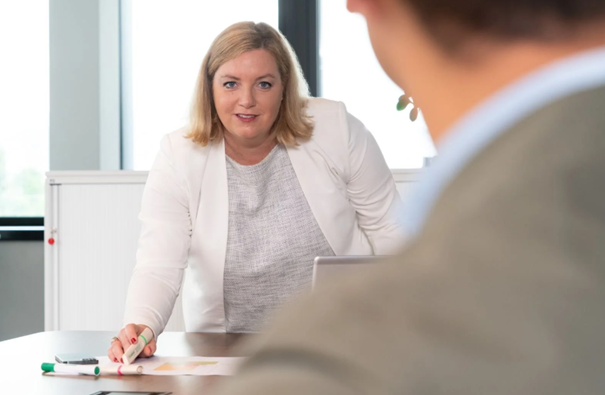
Digitalization is fundamentally transforming the world of work. What was unthinkable just a few years ago is now a reality: people can do their work from almost anywhere in the world. Some people come to the office only to interact with colleagues. Others, however, value their workspace at the office. Meetings take place in person, virtually, or in a hybrid format. What does this mean for employers? How should they design the work environment to meet all these needs? And how can they best foster creativity and productivity among their employees?
Workplace Advisory: Benefit from an International Network
The ISS Workplace Advisory team provides answers to these and similar questions. An experienced team develops design concepts for innovative work environments, conducts space analyses - including the resulting redesign of work environments - and thereby enhances the appeal of existing workspaces. “ISS’s strength lies in its ability to offer the entire service chain from a single source - from needs assessment through design concept development and construction implementation to operations,” explains Ulrike Bäuerle, Head of ISS Workplace Products and Performance.
In addition, the ISS team in Switzerland draws on the global expertise of the ISS Group, which places a high priority on workplace management. ISS is highly active and experienced internationally in the field of workplace experience. “ISS has just completed a survey on ‘Office Capacity Planning’ that was conducted internationally in 23 countries. It compiled the experiences of approximately one million office workers. The findings from such studies are directly incorporated into our work,” explains Ulrike Bäuerle. The experienced architect also actively participates in the group’s internal exchange of expertise. This gives her team access to the exclusive expertise of ISS’s international network.
Attractive Work Environments: Promoting Innovative Processes
Ulrike Bäuerle began her career in 2006 at what was then Australia’s leading architectural firm for workplace design. After seven years, she returned to Europe, where she most recently spent six years as a client representative at Porsche AG in Stuttgart, contributing significantly to the development of the automaker’s new work environment. Now she is putting her knowledge and experience to work for ISS’s clients. “We’re currently experiencing a disruptive moment in workplace design. In the wake of the pandemic, the processes of change - which were already being driven by digitalization - have accelerated exponentially. Companies must face this reality. And we’re here to support them,” she explains.
Today, companies are asking themselves whether individual workstations in offices still make sense at all. Studies show that many employees are particularly eager for social interaction, especially in the wake of the pandemic. But positive work experiences also contribute significantly to well-being. “If we create attractive and intelligent work environments, employees can work more productively and innovatively,” Ulrike Bäuerle is convinced. Optimal space allocation and the right amount of space - for example, for teamwork and informal meetings, as well as quiet work in sufficient quiet areas - are crucial in this regard. Companies that have recognized this are able to foster a sense of belonging even with hybrid work models, thereby reshaping and strengthening their corporate culture.
Thorough Analysis: Breaking Away from the Beaten Path
A well-founded analysis is always the first step toward creating an attractive work environment. This analysis determines, for example, how many quiet individual workstations are needed, how open meeting areas can be effectively designed, and whether the dining area should be used for multiple purposes. ISS Workplace Advisory assesses the nature of the work in the client’s relevant departments, examines which types of work need to be accommodated, and also takes the company’s corporate and communication culture into account. To this end, both employers and employees are surveyed.
“Our design proposals are then based on the project budget. A creative design doesn’t always have to be expensive,” the architect emphasizes. Rather, what’s in demand are innovative approaches that stray from the beaten path. So why not design the reception area like a coffee bar, expand it to include a coworking space, and incorporate the previously neglected courtyard? This surprises arriving visitors and creates entirely new opportunities for interaction.


Ulrike Bäuerle, Head of Workplace Management
Since November 2021, Ulrike Bäuerle has been responsible for developing strategies and new concepts for modern work environments as well as service offerings tailored to specific needs. She is supported in this by her team of specialists from the fields of food and hospitality, real estate management, and construction project management, as well as by international experts from the ISS Group. Ulrike Bäuerle studied at the Stuttgart University of Applied Sciences and the École d’Architecture et de Paysage in Bordeaux. She is a registered architect with the Baden-Württemberg Chamber of Architects.
Five Questions for Ulrike Bäuerle
What will the work environment of the future look like?
It’s not yet clear where this journey is headed. But the trend is toward collaboration and project spaces, as well as meeting areas, becoming more important, while personally assigned, permanently set-up workstations are losing priority. The pandemic has taught us that we can work from anywhere. I tend to come into the office to seek out interaction and collaborate with others, for example in a workshop. There’s also a growing trend of arranging to meet up with colleagues in advance to spend a day together in the office.
How important is the cultural context in workplace concepts, and what impact does it have?
Digitalization is also driving rapid growth in global collaboration. “Net-working” has become “net-worlding.” Many see themselves as modern nomads in the digital age. This creates entirely new cultural dimensions for companies. We’re all currently exploring what implications this has.
Why should companies design workspaces to create unique places?
An attractive work environment is key to attracting and retaining employees. When employees feel comfortable, they work better and are more productive. Since everyone’s needs are different, however, beauty is in the eye of the beholder here as well. Sometimes even small measures are enough to make a big difference.
Ulrike Bäuerle, you began your professional career in workplace design in Australia? What were your reasons?
I stumbled into workplace design by chance. When I graduated with a degree in architecture in 2005, the construction industry in Europe was in a total slump. Fresh out of college, it was nearly impossible to find a paid job. Australia was desperately seeking architects at the time—so I took my chance. I had no idea beforehand that this job would allow me to combine my passion for interior design with high-quality interior architecture.
You’ve been living in Zurich for a good six months now? What do you like about it? What do you miss?
I’m surprised by the multicultural diversity in Zurich. In addition to events organized by the expat community, there’s a wide range of cultural offerings - from modern to traditional - such as the recent Sechseläuten festival. Contrary to all the clichés, I also appreciate how open and friendly the people of Zurich are. So far, I don’t miss much. Only sometimes do I crave a plate of Swabian Spätzle with a good wine from Baden. But thanks to the local culinary diversity, I’m discovering all kinds of new delicacies to try.