The scientific evidence is clear: climate change poses a threat to our planet and all life on it. Yet we at ISS can and must play our part in helping to shape a positive future through sustainable action.
.png?width=1620&height=2025&name=Design%20ohne%20Titel%20(17).png)
As a global company, ISS has a special responsibility to minimize its environmental footprint and actively promote sustainable solutions. To this end, we have set an ambitious goal: We aim to achieve net-zero emissions worldwide by 2040. The ISS Group had already achieved its ambitious goal of reducing CO₂ emissions from its own vehicle fleet by one-third by the end of 2025 as early as the end of 2024. This milestone demonstrates that our commitment is making a difference and encourages us to consistently continue on our path toward sustainability.
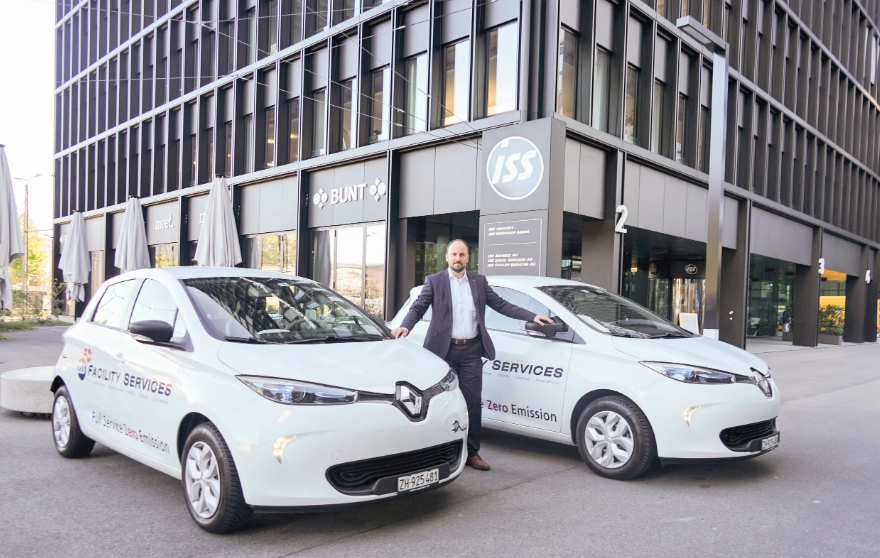
ISS Switzerland also takes this responsibility seriously. For example, we own one of the largest private vehicle fleets in Switzerland, and its electrification is a central component of our sustainability strategy. According to Patrik Havranek, Head of Group Fleet Management, the fleet comprises over 2,500 vehicles, 11 percent of which are already electric or powered by alternative fuels (such as hydrogen). Our goal is to significantly reduce CO₂ emissions. It is crucial that the electricity used comes from renewable energy sources, as electricity generation accounts for a significant portion of emissions.
Electric Mobility: Not Just a Matter of Technology
However, the transition to electric mobility also brings with it a number of challenges - challenges that, as Patrik emphasizes in our conversation, cannot be solved by ISS alone:
- Charging infrastructure: Expanding charging options - especially at our locations - is essential. While some countries already have innovative solutions such as “curbside charging” - which allows electric vehicles to be charged directly at the curb - Switzerland still lacks comprehensive coverage in many areas.
- Private charging options: Many employees have an agreement with ISS to take their company vehicle home after work. But not everyone has a suitable charging option at home.
- Power grid expansion: As the number of electric vehicles increases, so does the demand for charging stations. Adjustments are necessary to ensure that the power grid in buildings can handle this additional load.
- Electrified commercial vehicles: There are still numerous challenges, particularly in the delivery van sector. The available models often have insufficient range. Furthermore, a trailer or a heavy load further reduces the delivery van’s range.
These points show that the transition to electric mobility is not just a matter of technology, but also depends on infrastructure and practical solutions. Yet despite these challenges, we are on the right track and have achieved our 2024 goal of ordering 122 new electrified vehicles, 100 of which have already been delivered. In doing so, we are making an important contribution to sustainable mobility and significantly reducing our carbon footprint. These 122 electrified vehicles reduce our carbon footprint by 366 metric tons of CO₂ annually.
In the coming years, we will continue to focus consistently on innovation and environmentally friendly solutions to make not only our fleet but also our operational processes and infrastructure even more efficient and sustainable. Our commitment to a greener future remains unwavering!

Patrik Havranek
has been with ISS Switzerland since April 2007. In November 2021, Havranek - who holds a degree in business administration - assumed global responsibility for the ISS fleet in his new role as Head of Group Fleet Management. While he is also strategically responsible for the Swiss ISS fleet, operational management is handled by his Swiss fleet team.