Efficiently process and manage documents: With Document Services, ISS offers a solution for the digitization of mail and archives.


“Digitizing mail and archives speeds up the flow of information”
Olivier Rickenbacher, Head of Document Services
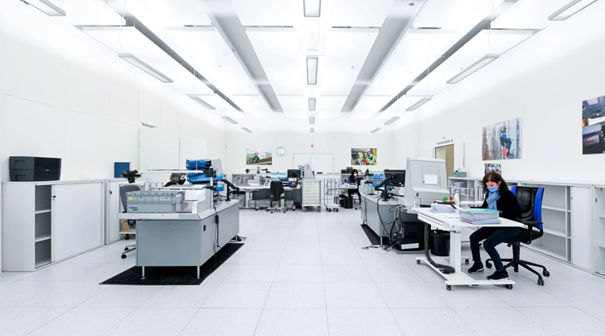
Since March 2021, things have been in full swing at Zurich’s new Mail & Scan Center. Nearly 30 ISS employees process more than 1.25 million pieces of mail and scan 1.4 million documents per year. In just twelve months, ISS has established a Mail & Scan Center for Zurich Switzerland featuring state-of-the-art technology, efficient processes, and the highest security standards. This enables Enterprise Content Management (ECM) in line with the latest industry standards. Here, content, data, and documents are made available to support core processes - a critical factor for the efficient operation of a financial services provider today. ISS is responsible for managing multiple channels within the ECM system, including external and internal mail, email, and archives.
 At the Mail & Scan Center, ISS employees process more than 1.25 million pieces of mail and scan 1.4 million documents per year.
Digitization is one of the core tasks
The digitization of paper documents is one of the core tasks in ISS’s service mandate. When processing such a large volume of documents in various formats, a systematic approach is essential. The following processes are distinguished:
Early Scanning
Early scanning involves processing incoming external mail. Thanks to presorting by DIE POST, ISS can open and scan the majority of mailings in a single step using state-of-the-art OPEX scanners. The remaining mail items are also fed into the scanning process after a multi-stage triage—provided they do not need to be physically delivered.
Late Scanning
In Late Scanning, closed cases and files delivered by the insurer’s case managers are scanned for the electronic archive.
Back Scanning
In back scanning, large physical archive collections are digitized on a project basis, for example, to identify patterns in specific claims.
In addition, there are numerous other special cases, such as documents that must be scanned but also physically delivered, content from microfilms, CDs, and USB drives, 3D objects (evidence) that are photographed, or the indexing of emails, in which the emails and attachments are converted and enriched with additional information. Since handling documents often involves sensitive data or personal information, security standards are very high.

Glasses or other evidence items are photographed and then digitally stored in the archive.
Experts and professionals handle the mail
ISS manages the mail counter at Zurich’s headquarters as well as three additional locations at various regional offices. These services require in-depth knowledge of the client’s organization and work processes. Not everything that arrives by mail can be scanned: advertising mailings are sorted out during triage, and greeting cards, for example, continue to be delivered to recipients in physical form. For such deliveries, among others, a courier is constantly on the move between the client’s locations in the Zurich area.
In addition to incoming mail, the ISS team also supports the client with outgoing mail, such as mass mailings, policies, invoices, and reminder letters. ISS also reviews and distributes the central email inbox. Added to this is the physical archive, which ISS manages in collaboration with a service partner after conducting a complete inventory and centralizing 33 kilometers of files.

To efficiently process several thousand pieces of mail daily, ISS uses modern software such as CodX PostOffice as well as high-performance equipment, such as a state-of-the-art postage meter.

Olivier Rickenbacher, Head of Document Services
After earning his bachelor’s degree in economics in 2018, he completed the ISS Global Management Trainee Program. He was able to deepen his knowledge directly while working with clients both domestically and abroad. Back at ISS Switzerland, as a project manager, his responsibilities included developing and launching the new Document Services division, which he has also headed since 2021.
Olivier Rickenbacher, you were the project manager for the development and launch of Document Services and now lead the division. How was ISS able to get up to speed on this new subject so quickly?
We submitted our proposal to Zurich with well-thought-out concepts. In addition, we can count on experienced partners for technical issues such as IT and data security. And finally, we were able to recruit long-time, experienced employees from the previous service provider for key positions in the new operation. Added to this was the exceptional dedication of all team members to overcoming the challenge.
For employees, switching providers means moving to a different employer. How did you address the uncertainty associated with this?
It requires open and direct communication to convince employees that this change will benefit them. We then adapted the processes so that the number of interfaces could be reduced and responsibilities precisely defined. These changes make the task more interesting for the employees who bear responsibility. That’s what convinced them.
Where do you see the advantages that ISS can offer the client for a project in the area of Document Services?
We have a highly specialized team that is technically well-equipped and can therefore work closely with the client to respond to new needs in an agile and flexible manner. By collaborating with strong IT partners, we can offer expert, modular solutions for digital mail processing and archiving - all from a single source - thereby helping to simplify and accelerate the flow of information for the client. We can also optimize costs in the long term - on the one hand through efficient processes, and on the other through a streamlined organization of all facility management and logistics matters.
"We can sustainably optimize costs through efficient processes and a streamlined organization of all FM and logistics matters."
What impact does the fact that ISS provides other FM services to the client have?
One of ISS’s key strengths is its large workforce. For labor-intensive additional tasks, such as packing a large shipment or relocating an archive, we can always mobilize the necessary personnel by drawing on additional staff from within the client’s own organization or from other parts of the company.
ISS also processes documents containing sensitive data. What precautions are necessary here to ensure security?
Data protection is a key priority for us, which we address at various levels. We establish physical security measures in the real world, such as biometric readers, security gates, surveillance systems, and opaque vehicles. We secure ourselves in the virtual space through technical security measures such as data encryption, two-factor authentication, strict access control, and a completely independent and secure IT infrastructure located in a Swiss data center. In addition, we continuously raise our employees’ awareness regarding the handling of documents and information, for example, by using e-learning modules.
Would you be willing to provide Document Services for other clients as well?
Getting started on the Zurich project was challenging, partly because the implementation took place under significant time pressure. But we’re quick learners and have already gained a lot of valuable experience in this short time - experience we’d be happy to apply to other projects as well.