Closing material cycles at customer sites: nearly three tonnes of collected plastic and over eight tonnes of CO₂ saved - that is the 2022 track record of ISS’s plastic recycling service. What began at our headquarters in Zurich is now actively practiced in 31 customer buildings. And this is just the beginning.
.png?width=1620&height=2025&name=Design%20ohne%20Titel%20(17).png)
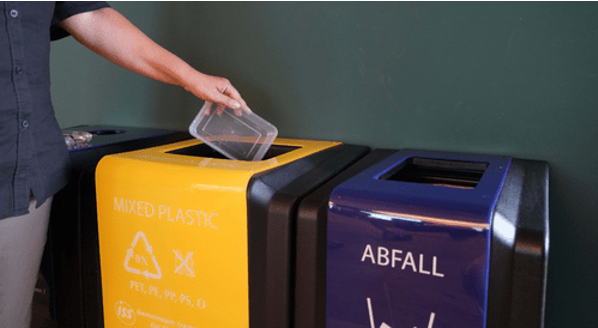
Promoting sustainable jobs - this is one of ISS’s most important strategic goals. After all, we share a collective responsibility for the planet we live on. Waste management is a lever that can be used to make a significant impact. Our clients want modern waste disposal infrastructure and aim to increase their recycling rates. That’s why we support them with our sustainable solutions to prevent and reduce waste wherever possible and, after proper sorting, recycle it.
Here’s how it works: Instead of individual waste bins at every workstation, central waste sorting stations are set up. The basic combination of collection stations includes PET, plastic, aluminum, and general waste. Depending on the volume of waste, cardboard, glass, batteries, and electronic waste are added. These collection stations increase motivation for the voluntary and proper separation of recyclables, leading to an improved recycling rate. To close the material cycle, ISS Switzerland promotes nationwide plastic recycling in collaboration with the certified “Bring plastic back” system from sammelsack.ch and InnoRecycling AG.
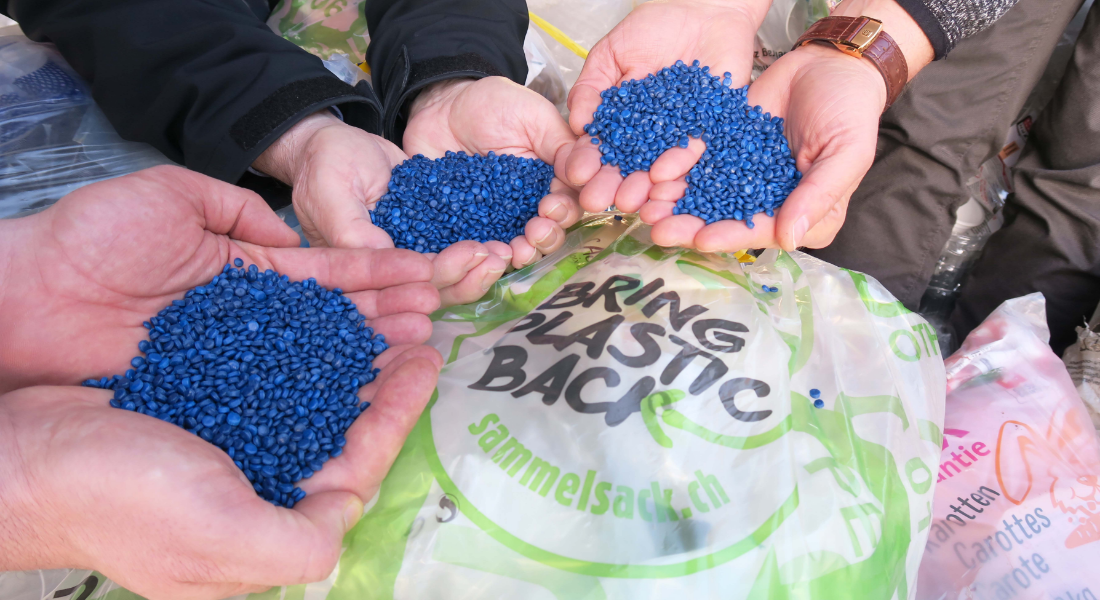
“BRING PLASTIC BACK” The collection system operated by sammelsack.ch and InnoRecycling AG is certified according to the strict requirements of the Swiss Plastic Recyclers Association. This certification includes regular monitoring using the method of the Swiss Federal Laboratories for Materials Testing and Research (EMPA). This guarantees a transparent, environmentally conscious material cycle and ensures that new raw materials are sensibly recovered from plastic waste.
1 metric ton of plastic corresponds to 3 metric tons of CO2
The plastic collected separately at recycling stations is picked up, sorted, and then converted into high-quality regranulate in Eschlikon, in the canton of Thurgau, from which new plastic products can be made. This reduces the amount of waste in office buildings by about 20 percent and minimizes greenhouse gas emissions accordingly. That’s because recycling one metric ton of plastic saves three metric tons of CO2 that would have been emitted if the plastic had been incinerated. Another positive effect is that the production of recycled plastic requires only half as much energy as the production of virgin plastic. In addition, three liters of crude oil are saved for every kilogram of regranulate made from recycled plastic.
ISS Recycling Service at a Glance

Figures for 2022
- Implemented in 31 buildings
- 2,916 kg of plastic collected
- 99% was sent for sorting
- 1,458 kg of regranulate produced
- 8,253 kg of CO₂ avoided
(8,253 kg of CO₂ is equivalent to 63,518.17 kilometers of CO₂ savings from car travel—enough to circle the Earth 1.5 times)
The more customers, the better
The plastic recycling service was launched at ISS headquarters in Zurich, and shortly thereafter, selected office buildings of our key accounts were added in an initial rollout. Across all contracts where the ISS plastic recycling service has already been implemented, 2,916 kilograms of plastic were collected last year. One aspect was particularly encouraging: 99 percent of this amount could be sent for sorting. Marc Amstutz, Head of Environment & Sustainability at ISS Switzerland, said: “This means that only one percent was too heavily contaminated by other materials that had been incorrectly disposed of and therefore had to go directly to the incineration plant. This is also due to the fact that processes are continuously being optimized and - where necessary - awareness-raising measures for proper separation, and thus for improving collection quality, are taking effect.”
“The nearly three metric tons of collected plastic is an impressive result,” confirms Livia Grimm, project manager at the system operator InnoRecycling AG / sammelsack.ch. “The companies collecting waste using the ISS system are thus actively helping to ensure that less plastic ends up in waste-to-energy plants. From the aforementioned collection volume, approximately 1.5 metric tons of regranulate are recovered through the recycling process. This is enough, for example, to produce over 1.1 km of plastic pipes.”
With plastic consumption of around 127 kilograms per person per year, Switzerland leads the way ahead of neighboring countries such as Germany and Austria - and 85 to 90 percent of this plastic is incinerated here after only a short period of use. That is why ISS is committed to ensuring that plastic is collected separately in the buildings we manage and sent for recycling. And, of course, our goal is to introduce this recycling service to as many customers as possible throughout Switzerland.
Less is more
At ISS, recycling solutions are always embedded in an overall strategy. In our waste management, we follow the 4R approach: “Refuse, Reduce, Reuse, Recycle.” We conduct awareness campaigns such as “Plastic Free Month” and have switched to plastic-free alternatives for office supplies and meeting room furnishings at ISS headquarters.