The coronavirus pandemic is changing how workspace is used. ISS advises clients on organizing and designing safe workplaces. Elisa Bensimon, Workplace Advisory at ISS, explains what this means for workspace design.
.png?width=1620&height=2025&name=Design%20ohne%20Titel%20(17).png)
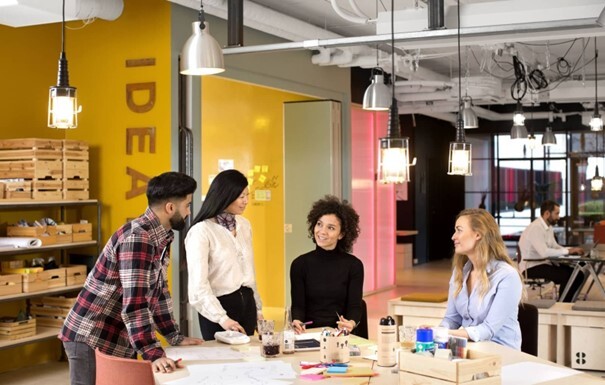
Innovative workspace concepts offer employees real added value compared to working from home - for example, in terms of health, creativity, flexibility, and enjoyment.

Elisa Bensimon, Workplace Advisory
She studied interior design in Rio de Janeiro, her home country of Brazil. She has lived in Switzerland since 2007 and earned a Bachelor of Arts in Interior Architecture from the Lucerne University of Applied Sciences and Arts. Before joining ISS, she worked for Meier Zosso Planungs AG and Mint Architecture.
Bensimon, how are you currently working ?
50 percent from home, 50 percent at ISS headquarters in Zurich-Altstetten. My employer provides me with the necessary technology and infrastructure to work - depending on my needs - at home or in the office, alone or in a group, “remotely” or “in person.” Not everyone has these options, not even at ISS. For example, it’s difficult to clean buildings from home.
You advise clients on the organization and design of workspaces. What kinds of needs are you currently facing?
The question is how employers can best protect their employees’ health without compromising work performance. While the increase in remote work eases the situation - since it makes it easier to enforce social distancing rules. Nevertheless, there are tricky situations - such as during peak hours and in high-traffic areas like elevators or break rooms.
How can you support your clients?
We analyze the spatial layout, measure occupancy rates, and identify hotspots. We then work with the client to develop a safety plan and implement it. For example, in high-traffic areas like hallways or cafeterias, we designate one-way traffic so that people’s paths don’t cross. Or we suggest designated time slots for employees to take their breaks, so that not everyone is in the restaurant at exactly 12:00 p.m. And, of course, we design countless informational signs and apply floor markings - spaced 1.5 meters apart.
How will the pandemic shape the workplace of the future?
We’ve been observing a trend toward flexible work models and hybrid workspaces for some time now. However, such a shift usually takes more time because it involves a learning process. The pandemic has abruptly changed the rules of the game and accelerated that learning process.
Why do we even need physical workplaces anymore?
First, working from home isn’t always possible for everyone. While digitalization enables a virtual workplace, it doesn’t take care of my four-year-old daughter. Second, I’m convinced that virtual space isn’t ideal for “thinking outside the box.” Spontaneous conversations are often the most inspiring. This requires appropriate spaces. Fundamentally, innovative space concepts offer employees real added value compared to working from home - for example, in terms of health, creativity, flexibility, and enjoyment.
What can ISS do for clients when it comes to repurposing office space?
We can support clients throughout the entire cycle of a space conversion. Using sensors, we can calculate occupancy rates and identify where spaces are used efficiently and where they are not. This frees up space to develop new usage concepts. Hardly any other company knows as many examples of inspiring and uninspiring spaces as we do. I think there will be more informal meeting places in companies in the future - more diversity, more flexibility, more loud and quiet spaces, and more emotion. Once the new usage concept is in place, we create CAD plans, implement them structurally, and, if necessary, even take over day-to-day operations.
ISS Real Estate Management
The ISS Real Estate Management Services division, led by Marcus Dolleck, handles all aspects of space utilization. The 45 specialists from the fields of real estate trust management, architecture, and building construction manage more than two million square meters of space for clients, develop space and workplace concepts, present space-related data graphically, and provide support for new construction, renovations, and relocations.