The HFR Hospital Group in Fribourg and ISS have been working together for 25 years. Andreas Berger, Director of Logistics at the HFR Hospital Group, explains how the partnership is evolving in this rapidly changing environment and what matters most.

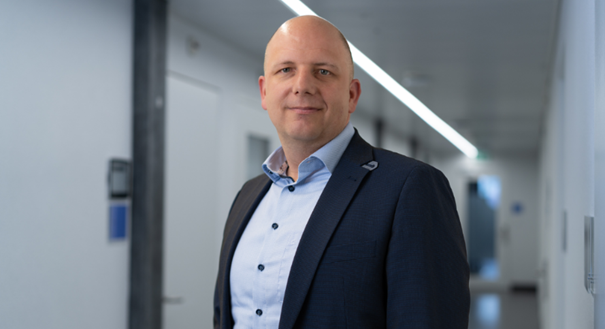
Andreas Berger, you are the Director of Logistics for the HFR Group. What responsibilities do you have in your department?
As Director of Logistics, I am responsible for supply chain management and procurement, medical and building services, hospitality and food service, cleaning, and transportation services for patients and supplies. I also oversee the real estate portfolio - which includes not only the four hospitals but also staff housing and parking lots - as well as construction project management, security services, and access control.
Would the hospital come to a standstill without a functioning logistics system?
Logistics is the engine and driving force behind hospital operations. Without hygiene, technical systems, supply chain management, or building maintenance, essential components needed to maintain safe operations would be missing. My employees and our service providers play a vital role in the entire system. They ensure that logistics runs smoothly. I have a great deal of confidence in our skilled staff and the external suppliers who support us every day with products and services.
What are the biggest challenges?
The biggest challenge is resource management. On the one hand, there is a shortage of skilled workers, which we’re feeling in both nursing and logistics. Despite increasing activity, the financial situation is critical: inflation and higher personnel costs due to wage indexation are not offset by higher rates or by the canton’s contribution for services in the public interest. We continue to work on improving our efficiency, but these factors - over which we have no control - weigh heavily on us.
The HFR has been working with ISS for 25 years, and you yourself have been at the HFR for just under ten years. How have facility management and our collaboration changed during this time?
The biggest change is the scarcity of available personnel. In the past, for example, ISS was only responsible for cleaning. Today, ISS also supports us in other areas beyond cleaning, such as room service. The labor shortage is now being felt at all levels and in all roles. These days, it’s hard to find staff even for simple tasks that don’t require any special qualifications.
The Fribourg Hospital (HFR) and ISS have been working together since 1999. The range of services includes a selection of support and service solutions tailored to the HFR’s needs. ISS provides maintenance and specialized cleaning services at two locations as well as in several office buildings of the cantonal hospital. At HFR Meyriez-Murten and HFR Tafers, ISS handles tasks such as bed cleaning, meal and laundry transport, and waste management. At the HFR Meyriez-Murten, ISS handles room service and the cleaning of the therapy pool, while at the HFR Tafers and the HFR Riaz, ISS is responsible for garden and grounds maintenance.

HFR Tafers (Photo: Charly Rappo)
In 2021, you decided to outsource services at the Tafers location to ISS as well. What are the advantages of having services provided by a facility management partner?
Various factors influence such a decision. Hospital operations and logistics at the Tafers and Meyriez-Murten sites have become increasingly integrated. Furthermore, due to the shortage of skilled workers, it was difficult to find a facility manager for the relatively remote Tafers site. That’s why we opted for an external solution with ISS. With ISS, we have a strong partner that can centrally provide services at both sites and handle personnel and absence management - tasks that typically take up a great deal of time.
How did you structure the outsourcing process in Tafers, and looking back, what were the key factors for success?
It’s never easy to integrate an external service provider into your own organization of experts, and the start is often bumpy. It requires a willingness to understand the other party, learn from one another, and break new ground together. The key success factors are open communication, mutual understanding, professional project management, and time. Until the collaboration is well-established, you should expect an outsourcing process on the scale of HFR Tafers to take at least 12 to 18 months.
How did the employees react to the outsourcing?
We were able to offer the affected HFR employees in Tafers an alternative position within our hospital group. This was greatly appreciated. As a result, there was little ill will or frustration among the staff, even toward ISS. HFR Tafers is a small, very close-knit organization, and it was no surprise that it took time for everyone to get used to the new “family member,” ISS, and the new processes. Changes in the hospital environment are very challenging due to strict hygiene requirements and patient safety concerns, and therefore require a great deal of coordination and collaboration.
In what specific ways does the partnership with ISS provide relief?
In three areas: First, as a global company, ISS provides us with best practices from the healthcare sector both domestically and abroad, with the goal of ensuring our operations run as smoothly and stably as possible. Second, we can benefit from their large pool of employees and outsource the labor-intensive task of personnel administration. Third, we’ve been able to slightly reduce operating costs. We’re also interested in innovations. However, we’re aware that, unlike in medicine, innovations can sometimes be difficult to implement in everyday hospital life, with its strictly regulated processes.
In your view, what is the key to a long-term partnership?
At the end of the day, it’s the people who matter. Through open communication and well-established collaboration, mutual understanding and trust have grown. The requirements are clearly defined and set forth in well-drafted, clear contracts and service specifications. It is very important to us that we have full transparency and that there are no hidden expectations on the part of either the client or the service provider.
You’ve been working for the Fribourg Hospital for ten years. What do you like about working here?
I was particularly drawn to the diverse challenges in the healthcare sector from the start. As a German-speaking Swiss, the linguistic and cultural diversity fascinated me right from the beginning. In the canton of Fribourg, German and French are mandatory, even in hospital operations. A hospital’s mission is also highly complex. It requires round-the-clock readiness from both medical and nursing staff as well as from logistics. Making a contribution and making a difference in this complex, constantly changing environment - that’s what appealed to me ten years ago and continues to drive me today.
About the HFR
The HFR is a publichospital with four locations spread throughout the canton, all situated in close proximity to patients. This combined expertise ensures diverse, high-quality care for the entire population of the Canton of Fribourg and beyond. Each year, the HFR treats more than 100,000 residents of Fribourg on an inpatient or outpatient basis. The range of services includes internal medicine, surgery, the emergency department, neurology, dermatology, and the maternity ward, as well as radiology, acute geriatrics, rehabilitation, and palliative care. The HFR also fulfills a training mission for physicians in collaboration with the University of Fribourg and for nursing staff through its Training Center for Nursing Professions.