Cleaning cleanrooms places the highest demands on specialist knowledge and working methods. ISS has been implementing hygiene concepts for leading pharmaceutical manufacturers for more than ten years, ensuring that operations run smoothly.
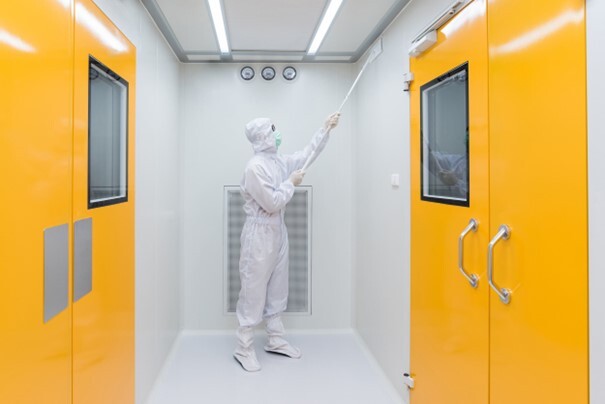
Strict guidelines apply to the research and manufacture of pharmaceutical products. Although germs and particles are microscopically small, they can interfere with the production of medicines. Therefore, hermetically sealed areas - known as cleanrooms - are required to control the concentration of germs and particles. In addition, the temperature, humidity, and pressure in the cleanroom must be continuously regulated and maintained at a constant level. And to ensure high hygiene standards, cleaning and maintenance in such areas are strictly regulated.
Cleaning Cleanrooms: A Work Environment with Strict Hygiene Requirements
The cleaning and maintenance of cleanrooms cannot, therefore, be compared to simple routine cleaning. Cleanrooms must meet strict structural and hygienic requirements and are typically divided into hierarchical zones. The process involves moving from the dirty zone through various areas to the cleanroom. In each zone, the maximum permissible number of particles is specified according to ISO standards, which also determines the room’s classification. To prevent germs or products from being carried from one room to the next, access is via a hygiene airlock; employees must wear the specified protective clothing and change it if necessary; and materials and equipment must be cleaned or disinfected. Understandably, the cleaning of these sensitive hygiene zones must also follow clearly defined processes.
Specialized Cleanroom Concept: Top Priority in Quality Assurance
In addition to legal requirements, various sets of standards are used as the basis for developing a specialized cleanroom concept. These include the Good Manufacturing Practice (GMP) guidelines and the guidelines of the Association of German Engineers (VDI). These contain specifications for quality assurance in production processes and for the components used, as well as regulations for the design of the cleanroom environment. This is intended to consistently prevent mix-ups, cross-contamination, and microbiological contamination. The Standard Operating Procedure (SOP) is derived from these specifications. The detailed description of the individual process steps ensures that tasks are always performed in the same manner and that prescribed measures are implemented.
Documentation is important: Complete documentation of all process steps
Documenting the tasks performed is of crucial importance and an integral part of the work. All employees working in this area are trained in “Good Documentation Practice” (GDP) in accordance with the ALCOA principle. Documented data provides complete transparency and traceability of the tasks completed. Documentation serves as proof that cleaning was performed under the correct conditions. It also serves as a quality indicator for the medications manufactured in these cleanrooms and enables traceability of the manufacturing process.
ALCOA Principle
-
Attributable: It is clear who created the data
-
Legible: The data can be read
-
Contemporaneous: I perform an action and record it immediately
-
Original: The data is recorded for the first time
-
Accurate: The data is complete and truthful
The ALCOA principle encompasses the fundamental requirements for data integrity as specified in the EU GMP Guidelines (Documentation, Computerized Systems), 21 CFR (Parts 11, 211, 803), FDA Guidance for Industry (Electronic Records; Electronic Signatures), and ISS SOP (PQMSG_Good Documentation Practice).
Selection and Training of Employees: Careful Recruitment
To meet customers’ high standards, ISS places great emphasis on the selection and training of employees. A strong awareness of hygiene, a willingness to work under demanding conditions, excellent health, and absolute reliability are therefore essential. During recruitment, emphasis is also placed on good language skills so that employees can understand work instructions and complete documentation correctly. Upon joining the company, every employee completes an ISS-internal, hands-on training program covering all relevant work areas in a cleanroom environment. In addition to basic training on how to conduct oneself in this specific work environment, this includes knowledge of ISS’s Cleaning Excellence program and a foundational understanding of microbiology and hygiene. Furthermore, subject-specific topics are covered in training provided by the client, and annual refresher courses are held at all levels.
As a leading organization in cleaning and specialized cleaning, ISS relies on a global supply chain, the exchange of international best practices, and structured innovation management. ISS has specialized in three areas within cleaning that are subject to strict requirements: hygiene for life sciences facilities and high-productivity high-tech industries; healthcare, with a focus on hygienic safety in all zones; and food production, where strict hygienic regulations govern food processing.

Dr. Regis Roland Masson, Head of GMP Services
has been responsible for GMP and cleanroom services in the pharmaceutical sector at ISS since 2013. He earned his Ph.D. in molecular and cell biology from Louis Pasteur University in Strasbourg. Before joining ISS, he gained extensive experience as a scientist, laboratory manager, and project manager in molecular biology and genetic engineering.
Three Questions for Dr. Regis Roland Masson, Head of GMP Services at ISS
To what extent is your scientific training relevant to providing the services required for this project?
Cleanroom hygiene is very different from regular maintenance cleaning. My scientific training, along with over 20 years of practical experience in various research and leadership roles, assures clients that ISS understands the requirements of this demanding environment and can implement them in practice. This expertise also helps us advise the client on how to further optimize hygiene standards. In this case, we analyze the cleaning processes, identify weaknesses, and propose corrective measures.
What does ISS do to keep its employees’ knowledge up to date for performing their work?
In this sensitive environment, it’s essential to stay up to date. We must comply with relevant GMP guidelines and keep pace with innovations. All ISS employees working in cleanroom areas undergo internal training upon joining the company on topics such as microbiology and hygiene, conduct in hygiene zones, and cleaning of hygiene zones, and are tested on this material in a final exam. To keep their knowledge current, refresher courses are held annually. Furthermore, all training sessions conducted are documented. We also place great importance on the exchange of information with the ISS Group. We benefit from the mutual transfer of knowledge and can use it to jointly develop best practices.
What do you see as the benefit for a customer in outsourcing cleanroom hygiene?
Hygiene in production facilities within the pharmaceutical industry must always be impeccable and is regularly audited by health authorities, such as Swissmedic or the FDA. In practice, in-house production specialists often perform the cleaning and disinfection of cleanrooms in addition to their daily duties. With its GMP Services, ISS can offer customers a specialized service package that ensures the standard-compliant execution and monitoring of maintenance, employee training, and the documentation of all activities and training sessions.
Keeping documentation up to date is particularly crucial, as it serves as key evidence during audits that all standards have been met. Furthermore, ISS employees are always on standby to initiate and implement necessary measures in the event of unexpected incidents. If, for example, a ventilation system fails, the affected hygiene zone must be thoroughly cleaned and disinfected after repairs are completed. By outsourcing cleanroom hygiene, the client can thus save a significant amount of time and redirect those resources toward tasks within its core business.