Swisscom has been committed to sustainable business practices for more than 20 years. The aim is for the entire value chain to be climate-neutral by 2025. Swisscom’s approximately 1,000 commercial properties are a key factor in reducing CO₂ emissions. A conversation with Jöri Engel, Head of Corporate Real Estate Management and CEO of Swisscom Immobilien AG, about energy targets, commitment and collaboration in facility management.
Mr. Engel, energy goals are a key aspect of sustainability - who sets these at Swisscom?
We have set ourselves the ambitious goal of becoming climate-neutral across the entire value chain by 2025 - that is, including our many suppliers and, consequently, ISS as well. Naturally, such a far-reaching step is the subject of intensive discussion within Group Management and the Board of Directors. Ultimately, however, everyone agreed that this is the right goal and that, thanks to our significant efforts in recent years, it is also achievable.
The targeted energy goals require financial investments. Why is Swisscom’s energy transition so important?
Of course, investments are needed for us to achieve our goals. But by reducing our electricity consumption, we can also save massive amounts of money. Here’s an example: Since 2005, we’ve equipped our telephone exchanges with an innovative fresh-air cooling system. This required structural modifications. But thanks to the resulting electricity savings, the investments paid for themselves very quickly. We’ve been so successful with this that we’re now using fresh air to cool our cell towers.
Nevertheless, the energy transition doesn’t come for free. We have a special responsibility - to people, to Switzerland, and ultimately to the entire world. That’s why we’ll continue to reduce our electricity consumption and our carbon footprint. It’s simply an important part of our Swisscom DNA.
What role does ISS play in implementing Swisscom’s energy goals?
You can’t achieve goals like these on your own. Ultimately, it comes down to a “collective effort” by many stakeholders in the relevant field. ISS brings everything needed to play a key role in achieving our sustainability goals in the building sector: enthusiasm for sustainability, creativity, technical expertise, and strong execution capabilities.
ISS assumes a kind of fiduciary role for Swisscom in the “Programs Engineering Construction Energy” division - where does this trust come from?
Through strong performance! It’s not as if ISS has always been in this position. At the beginning, we commissioned, monitored, and accepted the projects in the “traditional” way. However, the goal was always to continuously increase the level of autonomy at ISS. Thanks to strong results, transparent communication, and comprehensive reporting and documentation, we’ve been able to gradually step back. The people at ISS who manage this program for us in a fiduciary capacity are deeply committed to Swisscom and have the ability to make objective and factual decisions that protect our interests. And if an unclear situation ever arises, the lines of communication are extremely short. This is based on good structures and processes, but above all on having the right people in the right places and a corresponding culture of trust.
How does reporting work?
We work with a shared IT infrastructure where Michael Gräppi’s team systematically stores all analyses, proposals, and reports. There is no longer a fixed meeting schedule. ISS reaches out for consultation when they need decisions or the client’s opinion. We follow a “self-service” approach: If we want to know the details, we retrieve the relevant documents from the aforementioned shared repository.
What are the benefits for Swisscom of outsourcing this key function to ISS?
On the one hand, there is the increased professionalism and shorter turnaround times resulting from ISS’s extensive expertise; the relief it provides our organization from all tactical and operational processes in life cycle management, as well as the comprehensive, highly transparent documentation of projects - ensuring a smooth transition from construction to the operational phase.

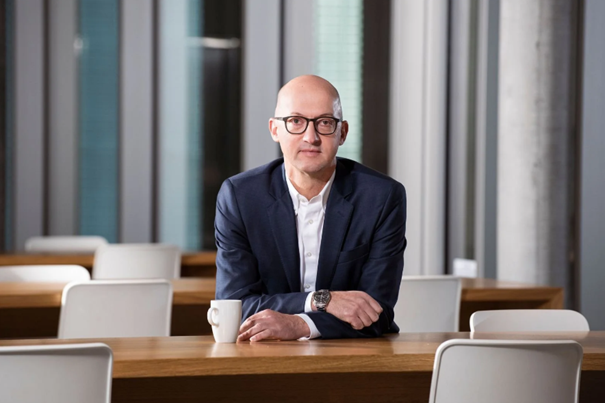
Swisscom values ISS’s ability to see the big picture and its unwavering drive to never rest on its laurels (pictured: Michael Gräppi, Head of the “Programs Engineering, Construction, and Energy” division)
Sustainability is part of Swisscom’s corporate strategy. How is this reflected both internally and externally?
Our commitment is rooted in a deep conviction shared by the entire senior management team to make a significant contribution to sustainability and, certainly, to serve as a role model. I hope this will inspire many other companies to get involved as well, each according to their own capabilities.
Finally, a blasphemous question: Can the global climate still be saved?
Yes! Because I am fundamentally convinced that countless people believe in this and are also doing their part to pass on this unique world to our next generations in a better state. In my view, it’s less about comparing who contributes how much. If everyone makes the contribution they can comfortably manage, that’s commendable, and we should value it as such. Many small contributions are still contributions!
Swisscom’s Commitment to Sustainability
Swisscom has been committed to sustainable business practices for over 20 years. In 1998, the company became the world’s first telecommunications provider to be certified under the ISO 14001 environmental standard. Since 2010, Swisscom has used only electricity from renewable sources. Its operations were already climate-neutral by 2020, and Swisscom aims to achieve this goal across its entire supply chain by 2025. In 2020, the Boston Consulting Group’s World Finance magazine named Swisscom the world’s most sustainable telecommunications company.