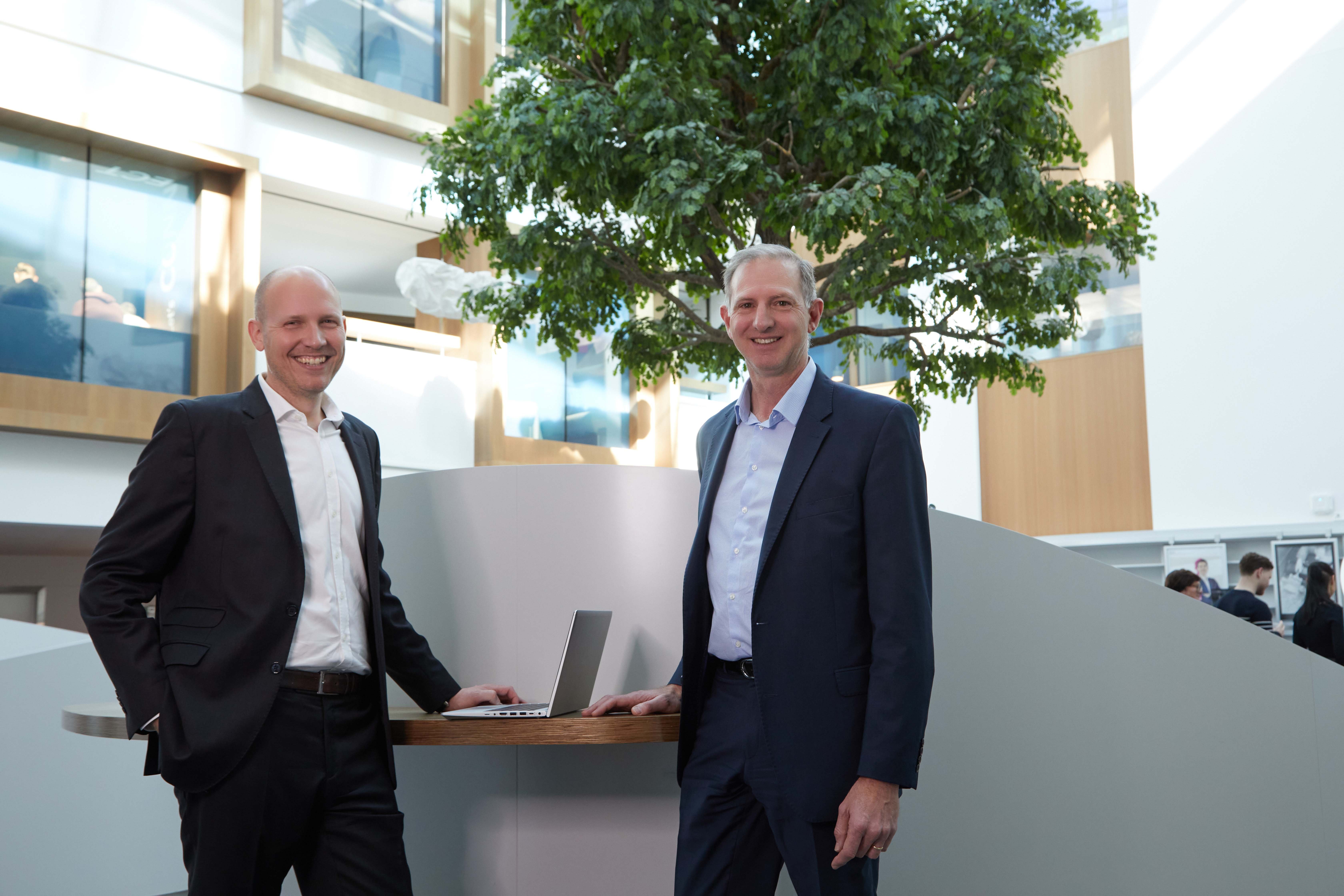
Giovanni Pons, Nestlé Swiss Workplace Solutions Business Partner and IFM Programme Manager, and Frédéric Traber, Head of Global Key Accounts West at ISS, have built a strong service partnership between Nestlé and ISS over the past ten years. At Nestlé Switzerland’s headquarters in Entre-deux-Villes, they tell us what matters most in this partnership.
From your professional careers, you’re both familiar with both the customer and provider sides. What surprised you when you switched roles? And how does that benefit your collaboration?
Giovanni Pons:
Understanding and being familiar with both sides paid off right from the start when I moved from the FM provider to Nestlé. My task was to transition the existing FM model to the Integrated Facility Management (IFM) model. With a project of this complexity, it’s not enough to just put together a PowerPoint presentation for management. You need teams by your side who fully support you. Thanks to my experience and knowledge, I was able to get all internal and external parties on board. We prepared for this change by involving all relevant stakeholders. That built trust. As a client, it’s also always important to me that the requirements for our partners are fair: You can’t expect 5-star service if you’re paying for 3 stars.
Frédéric Traber:
My career shift was exactly the opposite. I came from Nestlé and became an FM provider. I understand customer expectations - and also the potential frustration when the service provider fails to deliver the desired level of service. Today, I understand what goes on behind the scenes in facility management. This big-picture view has helped me build teams that are there for the client and do the job as well as possible. We want to offer our clients the right service at the right price - not the best service at any cost.
Giovanni Pons:
The experience that Frédéric and I share adds value. We respect both organizations, we understand the requirements, and we speak the same language.
ISS has been a partner of Nestlé for 25 years. How did the collaboration begin?
Giovanni Pons:
I started 20 years ago as a facility manager for Nestlé in Orbe. At that time, three companies were responsible for facility management, including ISS. Each company had a defined area of responsibility. From 2008 to 2014, the Nestlé Group introduced a new model: the “Managing Agent” model. In 2014, ISS won the entire FM contract for Switzerland through a competitive bidding process. That marked the start of the new integrated business model, which focused on the service partnership. It was a departure from the mindset that the client issues the order and the service provider carries it out. With the new model, ISS sits at the table with us as an equal partner. This required a transformation at every level.
What sets this partnership apart today?
Giovanni Pons:
In a partnership like this, you have to continually reevaluate and adjust the requirements, expectations, and the business environment. During our most recent negotiations to renew our partnership, one of the topics of discussion was how we could improve transparency with third-party service providers. ISS immediately presented us with a constructive proposal. For a strong and solid partnership, it’s important that both sides understand each other, are aligned, sometimes question certain things, and work together symbiotically to ensure a good service experience for everyone at our locations. I think that’s what we’ve successfully built together.
Frédéric Traber:
Here’s another example of the great trust Nestlé places in us: We were tasked with replacing the work uniforms for the entire workforce at Nespresso. The project took over a year and a half. We worked hand in hand with Nespresso on this. Since the rollout impacted existing internal processes, we needed access to internal information. That requires a great deal of trust in us. Today, the project is complete and a real success for both ISS and Nestlé/Nespresso.
Nestlé is one of ISS Switzerland’s five largest clients. 185 employees work daily at various locations, providing a wide range of services: cleaning, environmental waste management, green areas and grounds maintenance, technical maintenance, uniform management, relocation services, and reception services.
How is the range of services evolving within this model?
Giovanni Pons:
The range of services changes regularly, depending on how our sites develop and what services are needed there. With regard to the FM model, I spent a lot of time last summer focusing on one question: What is the best possible FM approach for our locations? Drawing on my experience, analyses, and benchmarks, as well as discussions with my colleagues, I developed our strategy, which defined the most suitable organizational and business model.
Frédéric Traber:
We streamlined the scope of work where there was overlap, such as in the maintenance of technical systems in factories, where Nestlé has its own expertise. For office buildings, research labs, and Nespresso boutiques, however, Nestlé entrusted us with more services. Here, ISS handles, among other things, technical services such as maintenance of electrical systems, HVAC, and building infrastructure. We focus on the locations and tasks that Nestlé wants to entrust to us and where we can deliver the greatest added value.
Are new technologies a focus?
Frédéric Traber:
Digital applications make sense where they support and simplify our processes: these include, for example, robots for large-scale cleaning at the research center or tablets to track when cleaning services were performed. In this area, we work closely with our specialists at headquarters in Zurich. They test new technologies and develop digital service solutions based on them. In addition, there are the ISS management systems.
Giovanni Pons:
ISS uses various tools. I’m thinking, for example, of the computer-based maintenance management system. Over 4,500 pieces of technical equipment are mapped in this system to plan and carry out preventive and reactive maintenance. Furthermore, data for KPIs and service tickets are also recorded electronically. As part of our integrated facility management approach, we want ISS to deliver the agreed-upon services, monitor them, and provide reports demonstrating that everything is proceeding according to plan.
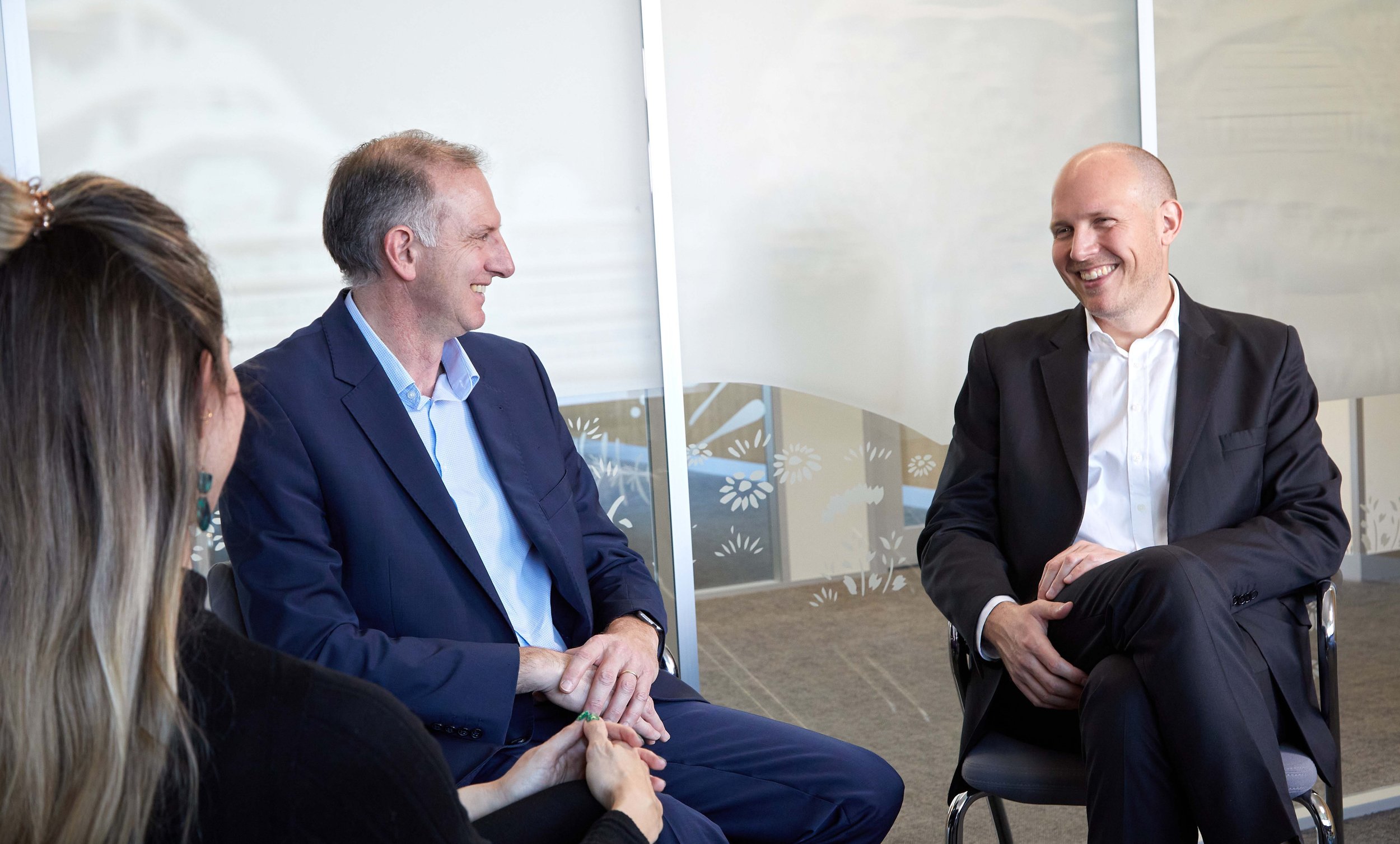
Discussing as equals: Giovanni Pons, Nestlé, and Frédéric Traber, ISS
ESG is a very broad and important topic for Nestlé. How does ISS support this effort?
Giovanni Pons:
With regard to our workplaces in Switzerland, we’ve done a lot in the environmental area in collaboration with ISS, with ISS proposing its own ideas and implementing the action plan. For example, energy-saving measures were implemented to reduce the risk of power outages, such as turning off the lighting for the logo or reducing lighting and temperature in the rooms. In the cleaning sector, ISS uses chemical-free products wherever possible. In one of my roles, I spearheaded the transition of the company fleet to 100% electric vehicles. This contributes to our goal of reducing our environmental footprint. And I know that ISS has also replaced vehicles with hybrid or electric models.
In the area of social responsibility, Nestlé focuses on engaging with the local community. For example, we host two daycare centers in our buildings in La Tour-de-Peilz. All necessary services have been defined, and ISS handles maintenance, cleaning, and laundry. Our restaurant partner, on the other hand, provides the meals. And during various initiatives, such as the well-known “World Clean Up Day,” the Nestlé and ISS teams at the Orbe site work together to collect trash.
Frédéric Traber:
For us, Health, Safety, and Environment (HSE) is a key priority. We do everything we can to raise awareness of workplace safety among our employees. Our HSE teams work closely with Nestlé’s HSE teams. They develop the rules, conduct training, advise the teams, and monitor compliance with the rules.

How would you describe the relationship between Nestlé and ISS employees?
Frédéric Traber:
Our 185 employees have played a major role in this 25-year partnership. They’re not just people who work on-site. They’re truly part of the family.
Giovanni Pons:
This is important for Nestlé, too. The ISS employees are proud of their work and identify strongly with Nestlé. They’re observant on the job and consistently provide valuable input. The ISS employees are also invited to our Christmas party. That might sound like a given, but it wasn’t always the case.
Frédéric Traber:
And all employees receive the same Christmas gift - from the cleaning specialist who cleans the offices for two hours a day all the way up to the manager.
Giovanni Pons:
The training sessions we conduct together with ISS on service culture are also important. Employees recognize the meaning and value of their work. That makes all the difference. I’ll never forget how, in 2018, the ISS cleaning team leader came up to me and asked if I’d noticed something on my desk. All I noticed was that the mouse was sitting on the keyboard. She explained that by placing the mouse on the keyboard and sliding it toward the monitor, you can tell whether a desk has been used and needs to be cleaned. She developed this as a best practice. This suggestion is now being implemented everywhere. It shows how important respectful, trusting collaboration is and that it motivates employees to contribute to an efficient, positive service experience.
Speaking of the service experience: How is quality ensured?
Frédéric Traber:
We’ve created a KPI matrix that highlights weaknesses and progress. If the KPIs are always green, they’re the wrong ones. This approach helps us continuously improve our performance. We also conduct joint quality control inspections from time to time.
Giovanni Pons:
First, as mentioned, we receive performance metrics for each location. Second, the ticketing system provides us with information about complaints. Third, we evaluate current and future projects during our weekly and monthly meetings. And users also regularly give us direct, personal feedback when we’re on-site. The metrics and feedback confirm it: Things are going well! Overall, we’re very satisfied.
Where do you see the biggest challenges?
Frédéric Traber:
As in most companies, the biggest challenge is finding and retaining skilled workers. If we don’t promote employees because things are going well on the assignment, they’ll leave and we’ll lose valuable expertise. That’s why we offer capable employees the opportunity to take on new roles and grow. In addition, ISS has established a strong culture of recognition, such as through awards for outstanding performance. In general, we have a relatively low turnover rate.
Giovanni Pons:
I agree with Frédéric. If you want to retain top talent, you need to offer them prospects for growth. If there are no development opportunities within a particular assignment, it’s better to offer the employee an alternative in a different assignment. That way, the talent stays within the organization and may even return to one of our Nestlé sites in a new role.
The contract was recently renewed. What goals and expectations are associated with it?
Giovanni Pons:
Why did we decide to renew the contract? Because it’s working well and because we have a strong and solid partnership. We have the right points of contact who understand and address our expectations and who are able to embed the mindset for this new contract within the organization. Our expectation for the future is to maintain this, strengthen it further, increase efficiency, and promote best practices.